バナー
ブログ

From a Piece of “Foam” to a Pencil Case

ブログ

From a Piece of “Foam” to a Pencil Case

December 10, 2025

8-Step Breakdown of the EVA Thermoforming Storage Box


The complete manufacturing process of a thermoformed EVA case can be divided into eight stages: EVA material preparation →Selection of Surface Materials→ EVA cutting → logo or pattern processing on boxes → pre-pressing → thermoforming → cooling and trimming→ stitching, then inspection and packaging, a versatile EVA storage box is completed.

The key process parameters are concentrated at the thermoforming stage.

Below is an explanation of each step in order, along with commonly used control ranges, making it easier for brands to reference directly when designing and customizing pencil cases or EVA storage boxes.


1. EVA Material Preparation


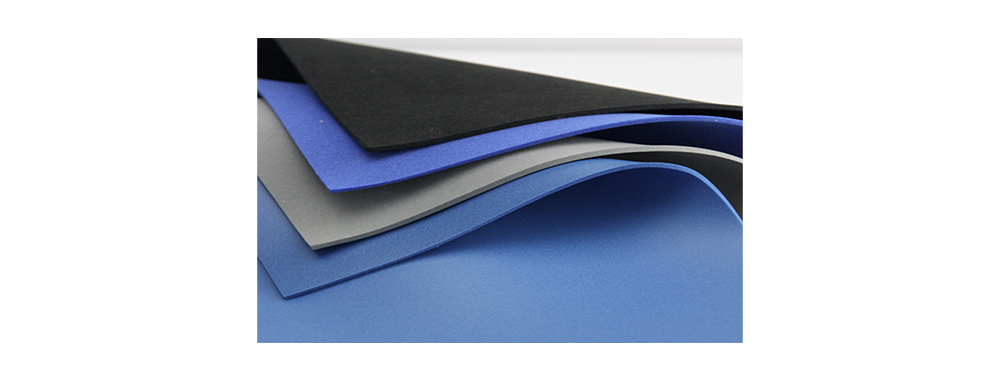
Select EVA with suitable hardness: depending on the required wall thickness and firmness of the pencil box, choose EVA foam sheets with a density of 200–300 kg/m³ and a hardness of 55–80 degrees.

For lightweight small EVA cases - such as eyeglass cases or ipod case -EVA with a hardness of 65 degrees is recommended.

For tool cases or electronic product storage box, a hardness of 75 degrees or above is recommended to ensure the case maintains its shape and does not deform easily.

 EVA Material

2. Selection of Surface Materials for the Case


After choosing EVA sheets with the appropriate hardness, the next step is selecting the surface fabric to be laminated onto the EVA sheet. The most commonly used option is polyester knitted fabric, which has a smooth surface, excellent elasticity, and relatively low cost - making it the first choice for most standard EVA cases.

In addition, customers may select customized materials based on their product requirements or brand positioning. For example, PU leather laminated with EVA is often used to make item such as pencil box and EVA organizer case.

 Polyester Knitted Fabric and PU

3. EVA Laminated Sheet Cutting


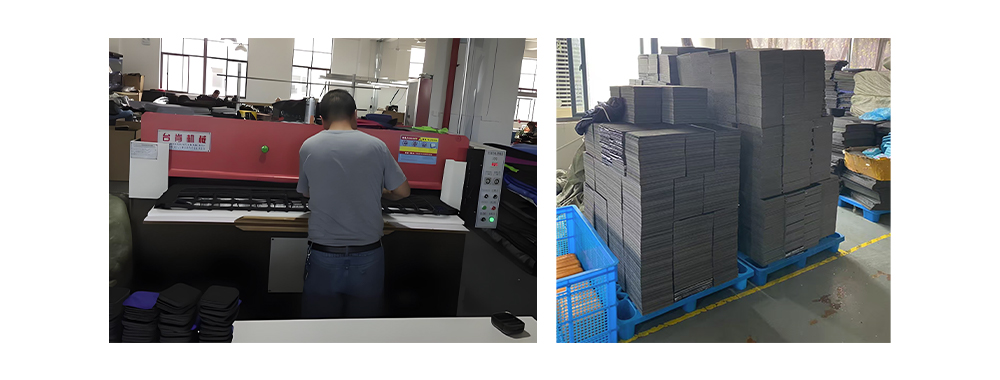
Lay the laminated EVA sheet flat and cut it into individual pieces. The cutting size should be approximately 20 mm larger than the perimeter of the mold. This extra allowance ensures that materials with different shrinkage rates have enough room to stretch, and it also prevents material shortage during the thermoforming process.

 EVA Laminated Sheet Cutting

4. Laminated Fabric Surface Logo or Pattern Decoration


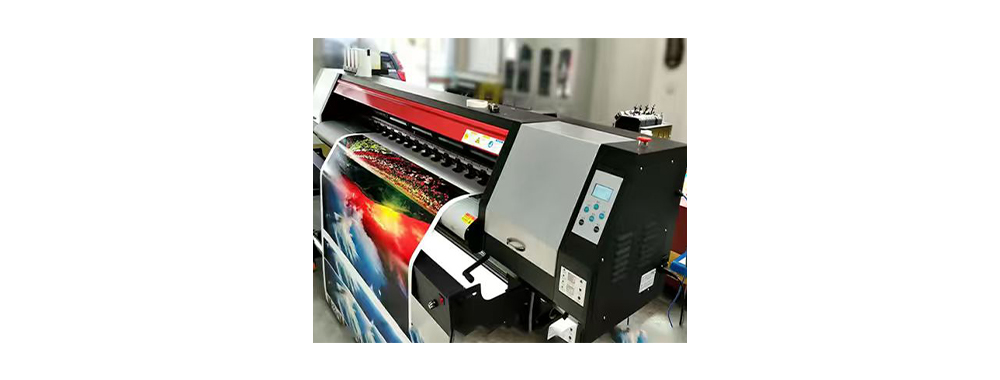
4.1. The decorative patterns or logos on the EVA box can be silk screen printing or heat-transfer printing or sublimation print. These prints will not be affected by the subsequent thermoforming process.

 Sublimation Print

4.2. Debossed logo: The pattern or logo can also be debossed directly onto the thermoforming mold, allowing it to be formed in one step. In this case, no additional logo decoration is required as above.

 Debossed logo

5. Pre-pressing (Cold Press Shaping)


First, preheat the material in a 60–80 °C oven for 30–60 seconds, this helps shorten the subsequent thermoforming cycle and improves surface flatness.

Then, place the cut sheet into the cold-press mold and apply 2–4 MPa of light pressure for 5–10 seconds. This allows the sheet to initially conform to the mold, reducing sliding or shifting during thermoforming and minimizing wrinkles.


6. EVA Thermoforming


This is the core process in producing a thermoformed EVA case. Using a four-column thermoforming machine with electrically heated platens and independently controlled upper and lower mold temperatures, the final shape of the case is essentially formed.

  • Mold temperature: 120–180 °C, controlled by a mold-temperature machine with ±2 °C accuracy.
  • Pressure: 10–40 MPa (adjust based on wall thickness and depth; deep cavities require the upper limit)
  • Thermoforming time: 45–90 seconds

~45 s for 3 mm wall thickness

~60 s for 4 mm wall thickness

For every additional 1 mm of EVA thickness, increase thermoforming time by 10–15 seconds

  • Operation sequence: fast mold closing → staged pressurization → 1–2 exhaust cycles → high-pressure holding → slight mold opening for venting → cooling and final shaping.

 EVA Thermoforming

7. Cooling and Trimming


  • Cooling: after the holding phase, immediately introduce cooling water or air to bring the mold temperature down to below 50–60 °C before opening the mold. Insufficient cooling may cause the thermoforming cases or boxes to rebound or the edges to warp.
  • Trimming: depending on the thickness and hardness of the EVA composite material, you may use traditional die-cutting, a CNC punching machine, or a laser cutter to remove the excess material along the outline in a single operation. When using laser cutting, stitching guide lines, zipper channels, and other features can also be cut simultaneously, eliminating the need for secondary processing later.


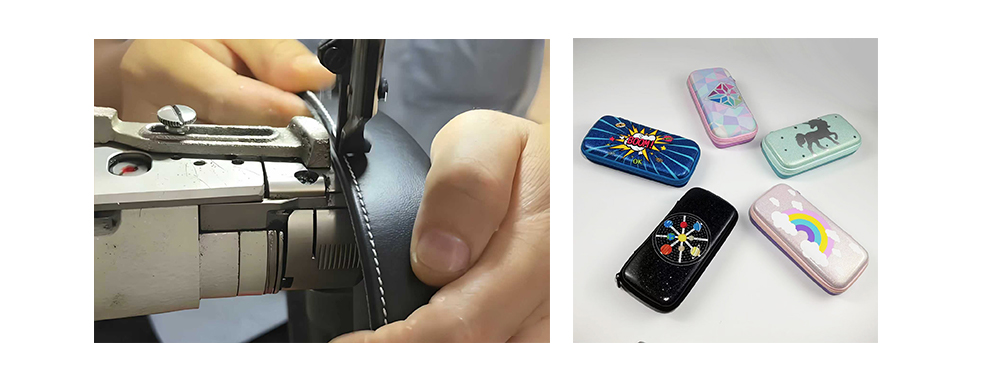
8. The final step is sewing the boxes


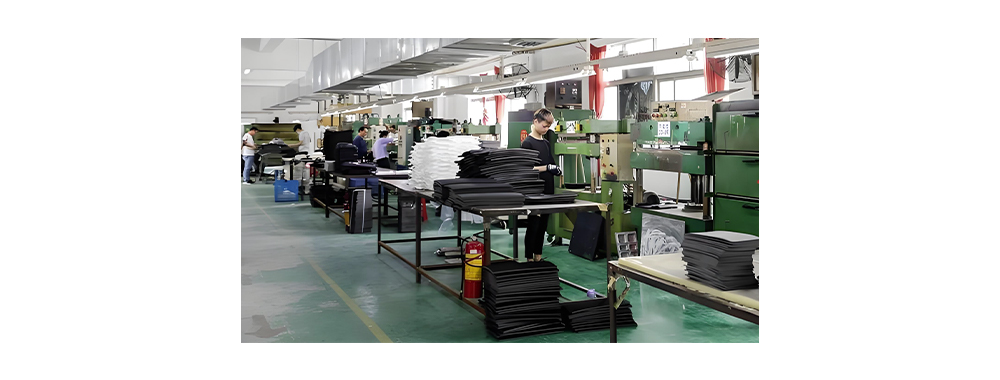
Sew the thermoformed EVA cover or bottom case together with zipper tape and other components like webbing carry handles, add hardware such as rivets or logo patch through a pneumatic riveting machine, by here the assembling process of one pencil case or storage box is nearly finished.

Last but not least, Inspection & Ticketing before packing into master cartons.

  • Appearance check: No pressure marks, bubbles, color differences, or wrinkles.
  • Dimensions check: Length/width/height tolerance of ±0.5 mm.
  • Pencil case/Storage Box Performance Test: The zipper must withstand 500 times back-and-forth cycles without tooth loss or abrasion.
  • Drop Test: Pick a few units, drop them from the set height onto a hard surface on all six faces/edges/corners, check after each drop, and confirm stored stuffs inside the boxes still work at the end.
  • After passing inspection, pencil cases / storage boxes are packed into polybag and then placed into the master carton.

  Sewing the boxes


Highlights of Key Control Points for Thermoformed EVA Boxes


1.Temperature and pressure must work together:

For every 5 °C increase in temperature, the pressure can be reduced by 1 MPa, and vice versa.


2.Ensure smooth mold venting:

Deep cavity molds require 0.05–0.1 mm vent grooves to prevent burnt edges and reduce issues such as surface bubbling or localized delamination of laminated fabrics during forming.


3.Cooling time accounts for over 40% of the cycle:

Test for the optimal cooling duration before mass production. Reducing unnecessary cooling time can significantly improve productivity.


4.Sheet moisture content >0.1% easily causes bubbles:

During continuously rainy or humid days, it’s recommended to pre-dry the sheets at around 50 °C for about 3 hours before production.


5.Perform first-article inspection each shift and patrol inspection every 2 hours:

Record temperature, pressure, and cooling time. Stop the machine immediately and adjust the mold if deviations are found.


By following the above procedures and parameters, a standard 5 mm wall-thickness EVA case can achieve a daily output of 1,200 pcs per machine, with a ≥98% yield rate.

  Author  


ホットタグ :
お問い合わせ
住所 : Unit 905, Block B, Jinri Building, No. 88 Anling Second Road, Huli District, Xiamen, Fujian, China
連絡する

ぜひ読んで、投稿を続け、購読してください。ご意見をお聞かせください。

Linkedin WhatsApp Facebook instagram

著作権 @2024 Synberry Bag & Package Products Co.,Ltd 無断転載を禁じます . サポートされているネットワーク

サイトマップ / ブログ / Xml / プライバシーポリシー

伝言を残す

伝言を残す
私たちの専門知識がどのようにして最高品質で魅力的な製品を提供できるかについて話し合えることを楽しみにしています。ここから会話を始めてください。つながり、創造しましょう!
提出する

製品

ワッツアップ

お問い合わせ