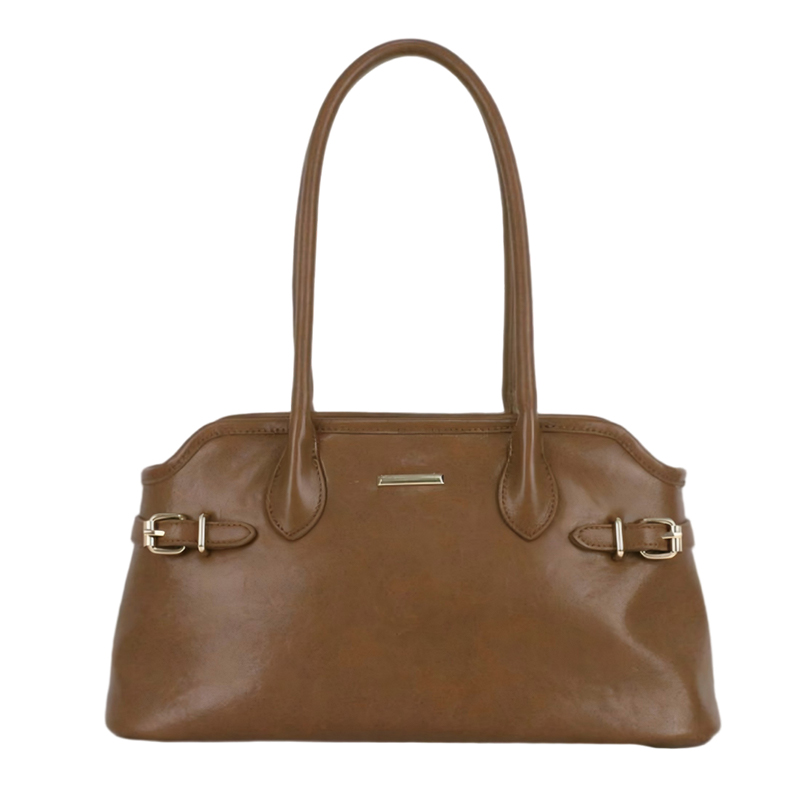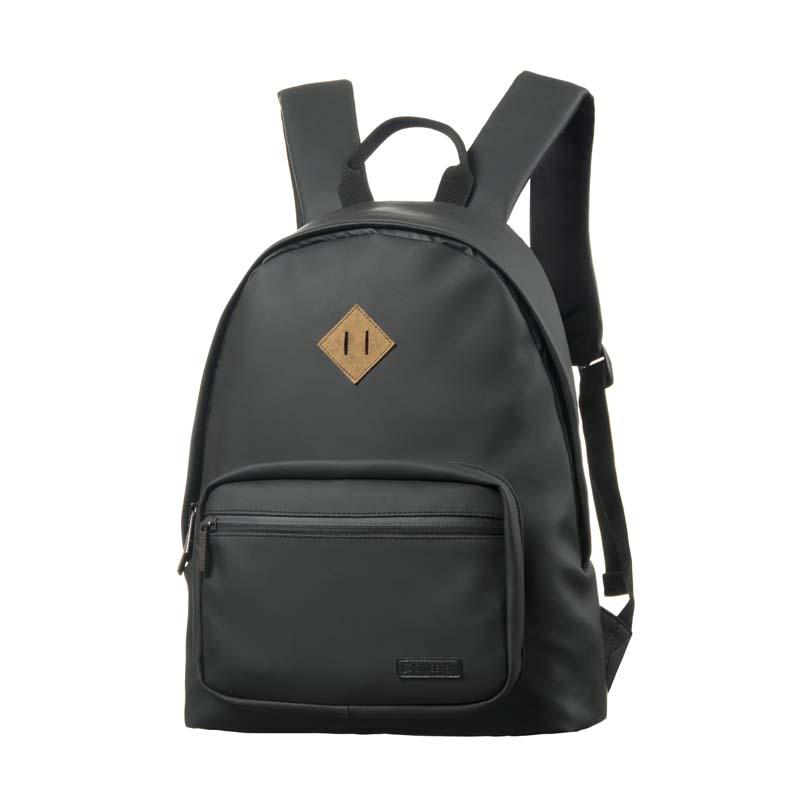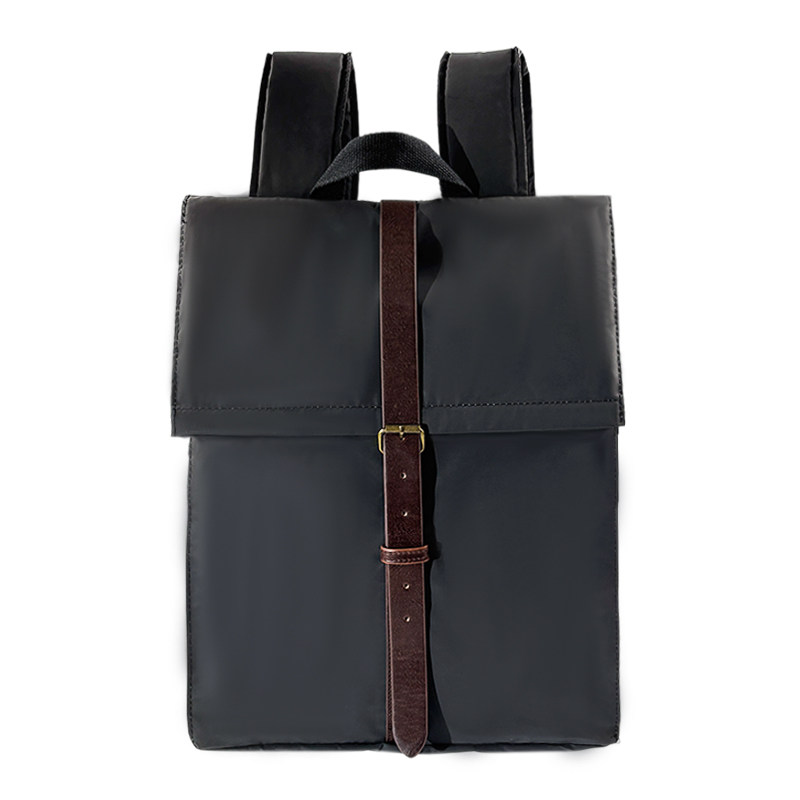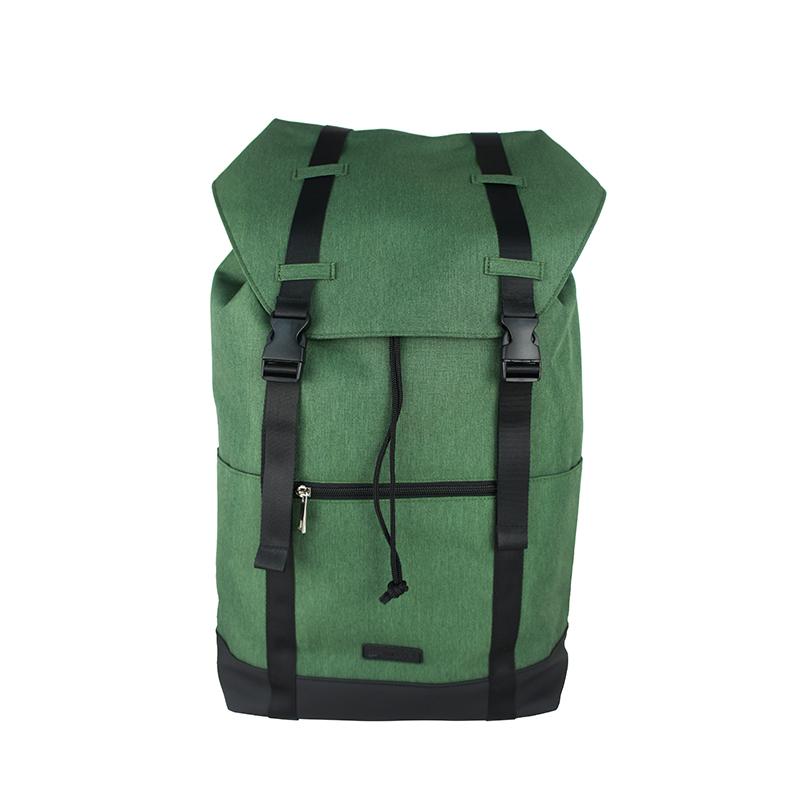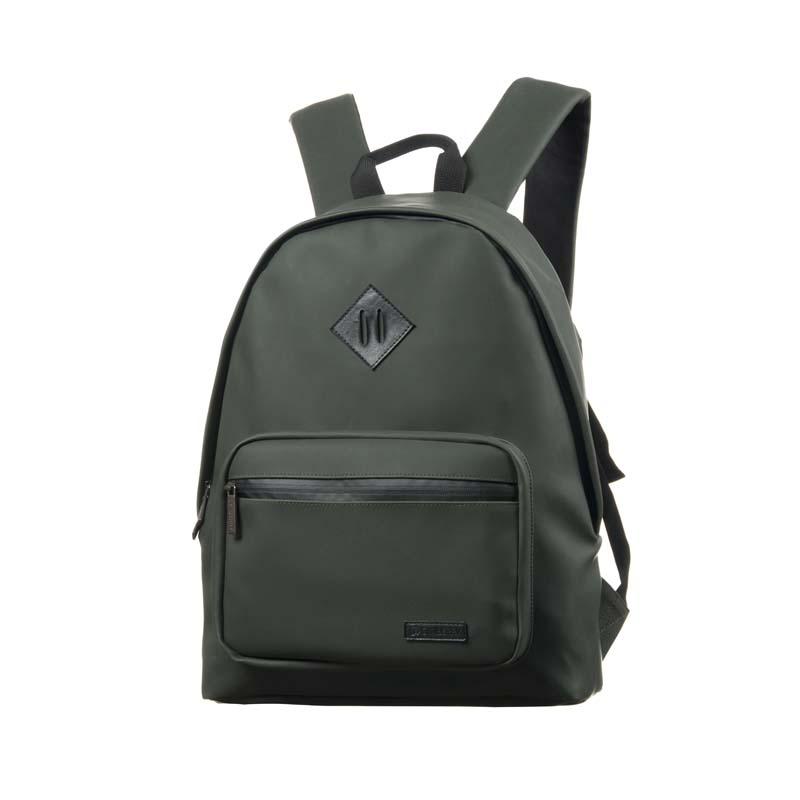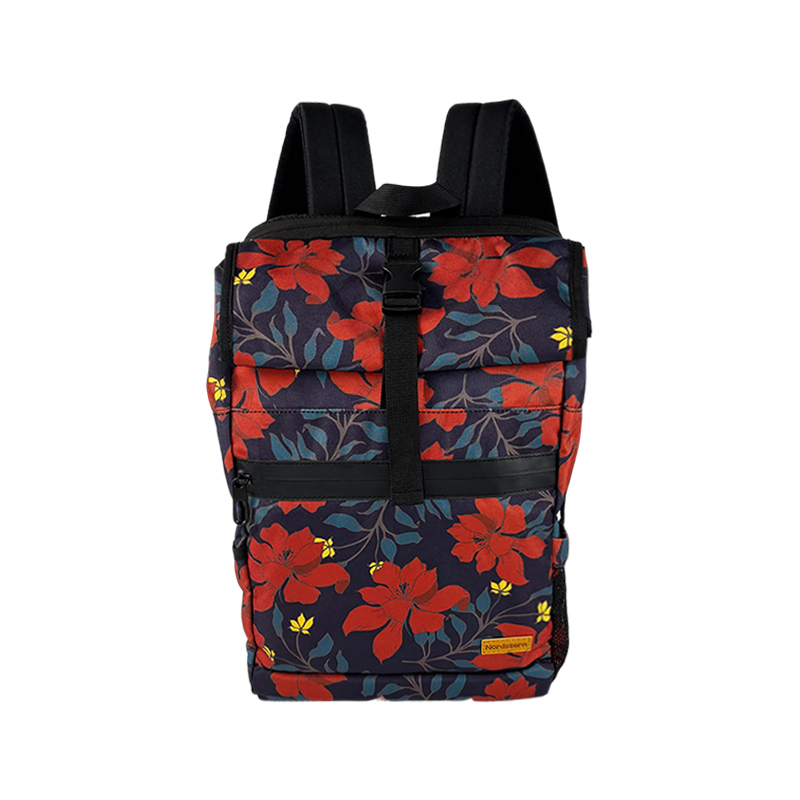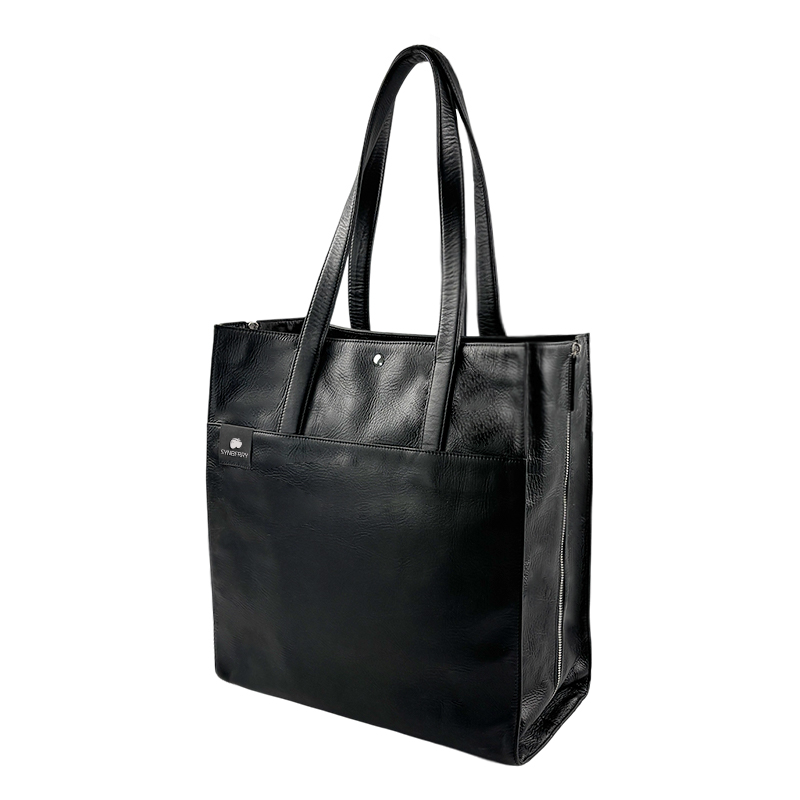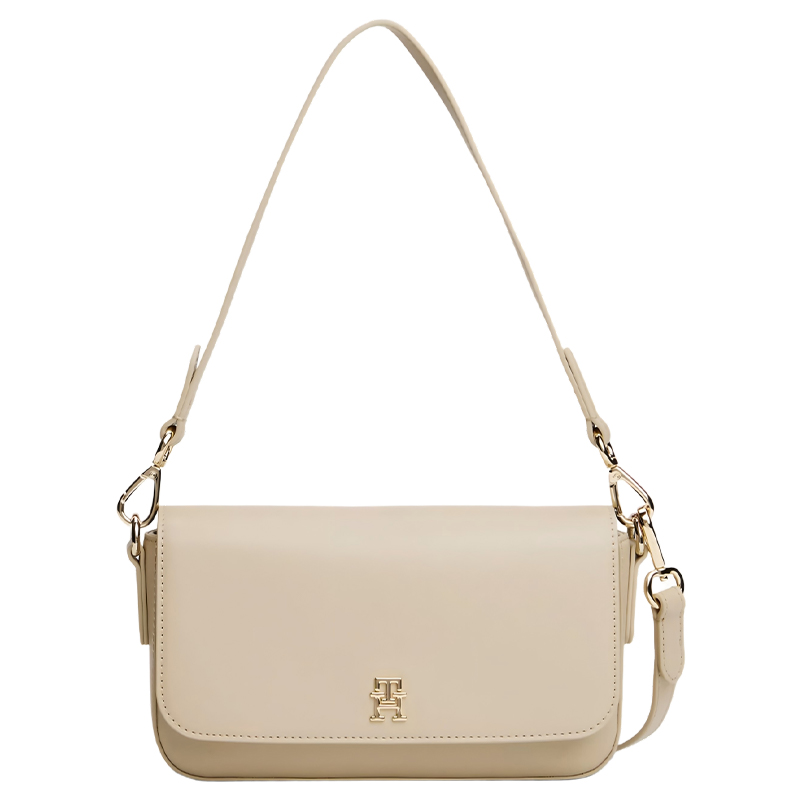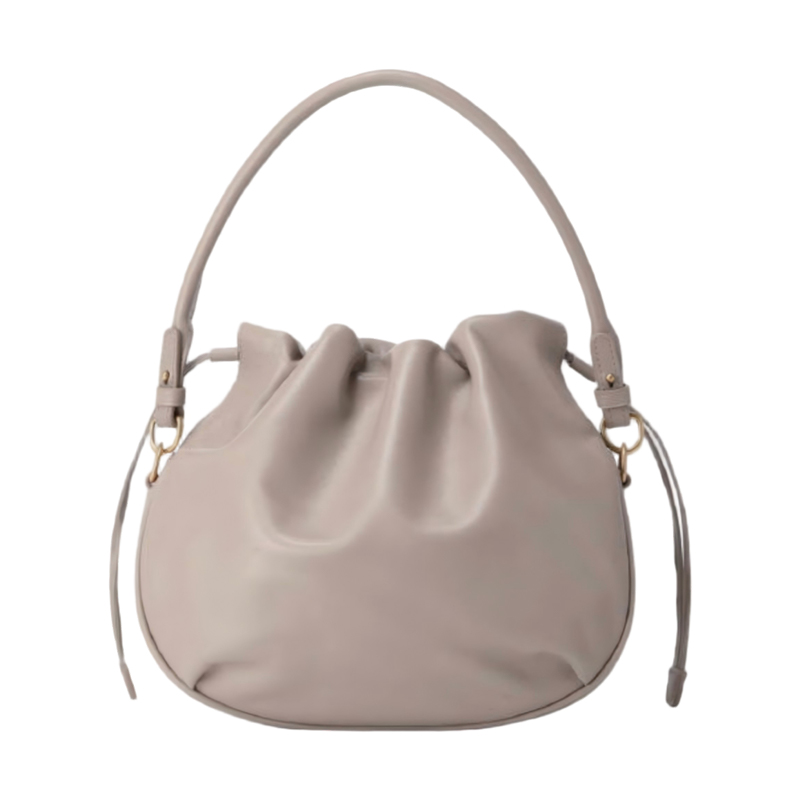


当社のプロフェッショナルな製品カスタマイズ サービスは、お客様のアイデアを現実に変え、コンセプトから小売店の棚に製品を展示するまでのシームレスな体験を提供します。


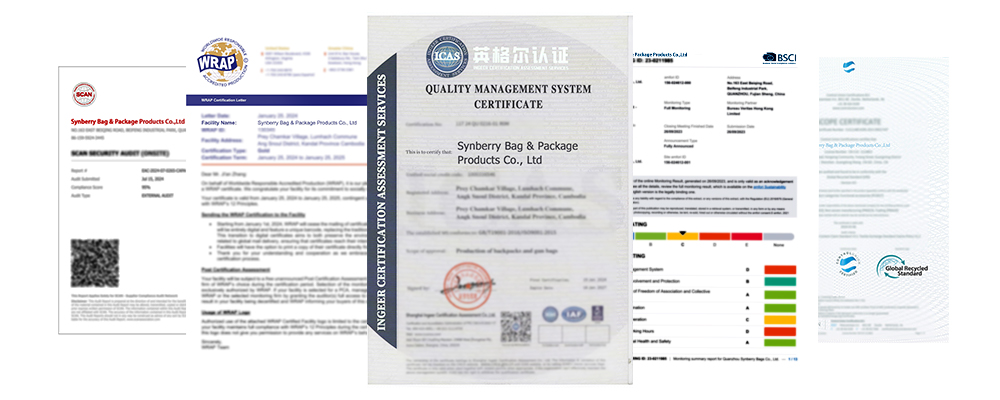
Synberry が 2 世代にわたって選ばれた理由は何ですか?明確に定義された品質原則、適切に管理された文書と記録、そして最も重要なことに、詳細なプロセス分析と検査により、当社は一貫した高品質を保証することができます。

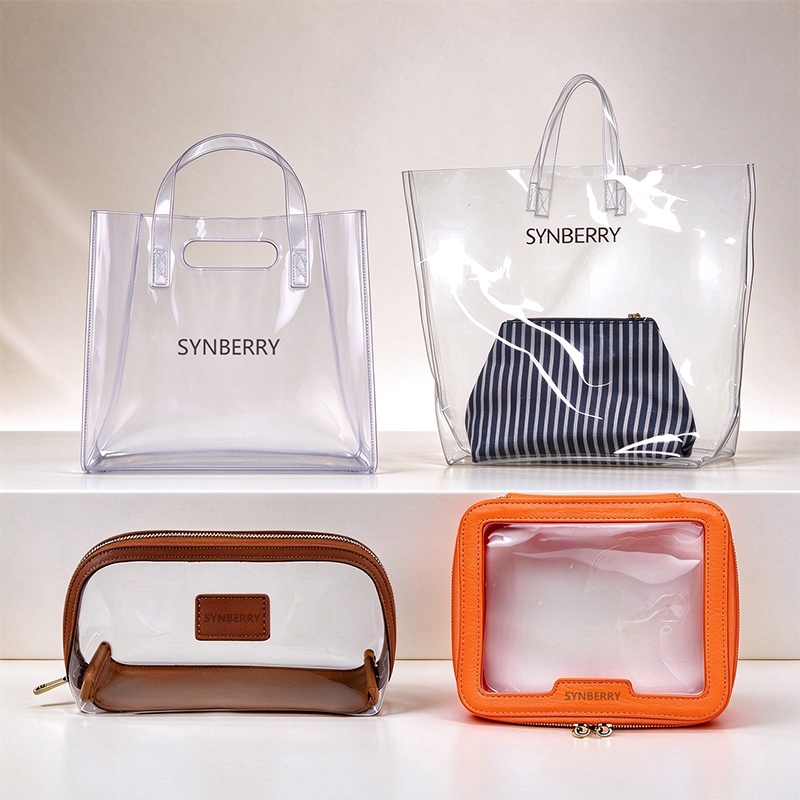
During the OEM production of transparent bags, PVC, EVA, and TPU are the three most frequently mentioned materials. Among them, PVC has the widest range of applications, TPU offers the most balanced overall performance, while EVA is irreplaceable in specific applications due to its soft feel. Taking common transparent bag applications as examples: PVC, with its highest transparency and lower raw material cost, has long dominated the markets for fast-fashion packaging, promotional gift bags, and mass-produced transparent handbags; TPU, thanks to its excellent elasticity and recovery, low-temperature resistance, and abrasion resistance, has become the preferred choice for high-end cosmetic bags, outdoor waterproof bags, medical device packaging, and transparent storage products that require repeated use; EVA is more commonly used in baby products, stationery pencil cases, and as a lining material in multilayer composite structures where softness and cushioning are important requirements. Table of Contents Differences in Composition Differences in Performance Environmental Friendliness, Compliance, and Safety How Should Brands Make Their Choice? Frequently Asked Questions (FAQs) I. Differences in Composition PVC (Polyvinyl Chloride): PVC is a chlorine-containing vinyl polymer that is inherently rigid. Plasticizers (most commonly phthalates such as DOP/DEHP) must be added to make it into a soft, transparent film. Among the three materials, PVC offers the highest transparency and the strongest “crystal-clear” appearance. It also has the lowest raw material cost, which is why PVC has long dominated the low-end transparent bag market. EVA (Ethylene-Vinyl Acetate Copolymer): EVA is a copolymer of ethylene and vinyl acetate. Its softness is determined by the vinyl acetate (VA) content in the molecule: the higher the VA content, the softer and more transparent the material. EVA has natural flexibility without the need for plasticizers, which is the most fundamental difference between EVA and PVC. TPU (Thermoplastic Polyurethane): TPU is a block copolymer whose molecular chains contain both hard segments (which provide strength) and soft segments (which provide elasticity). As a result, it combines the elasticity of rubber with the processability of plastic, making it the only “elastomer” among the three materials. II. Differences in Performance 2.1 Transparency and Appearance: PVC > TPU > EVA PVC: Offers the highest light transmittance and the lowest haze, creating a visual appearance closest to “glass.” TPU: Ranks second in transparency. High-transparency TPU films can achieve light transmittance of over 90%. EVA: Typically has a light transmittance of around 85% and may appear slightly translucent, especially when the VA content is high. It offers the soft texture of “frosted crystal” rather than the sharp, crystal-clear transparency of PVC. 2.2 Softness and Hand Feel: EVA > TPU > PVC EVA: The softest of the three materials. With a Shore hardness of 60–70, it feels almost structureless when held in the hand. However, EVA's softness is associated with permanent deformation, meaning that creases tend to remain after folding. TPU: TPU offers a completely different type of softness—it is characterized by elastic recovery. When pressed or squeezed, it quickly returns to its original shape. PVC: The softness of PVC depends on the addition of plasticizers. Its hand feel often has a distinct “slippery” or “rubbery” texture, lacking the warm, smooth tactile quality of premium fabrics. It also tends to harden at low temperatures. 2.3 Temperature Resistance: TPU > EVA > PVC TPU: The best performer, typically with a temperature resistance range of -30°C to +80°C. It does not become brittle at low temperatures or soften and deform at high temperatures. EVA: Ranks second, with a temperature resistance range of approximately -20°C to +60°C. It tends to soften and stick together at high temperatures. PVC: The weakest performer. It becomes hard and brittle at low temperatures, making the corners prone to cracking in winter. At high temperatures, plasticizers may migrate out of the material, causing the film surface to become sticky. 2.4 Abrasion Resistance / Surface Scratch Resistance: TPU > PVC > EVA TPU: Has an absolute advantage in abrasion resistance among the three materials. This makes it almost irreplaceable in applications involving repeated friction, frequent contact with the contents, or long-term carrying and use. PVC: Ranks second. Its surface is initially glossy, but its overall abrasion resistance is weaker than that of TPU after repeated friction. However, the scratch resistance of high-quality PVC films has improved significantly through adjustments to their formulations, including surface hardness. EVA: Although the material is relatively soft, its surface strength is limited. It is more prone to scratches and abrasion marks during use, especially at the corners of the bag and in areas subjected to stress and repeated folding. After long-term use, its transparency and overall appearance deteriorate noticeably. 2.5 Visual Lifespan: Resistance to Yellowing and Whitening During the long-term use of transparent bags, resistance to yellowing and haze formation directly determines the product's visual lifespan. The differences among the three materials in this dimension reflect real-world user experience more accurately than short-term performance data. Yellowing and whitening have different causes. Yellowing mainly occurs when the molecular structure of a material undergoes oxidative degradation after exposure to ultraviolet light, thermal oxidation, or contact with certain substances, resulting in the formation of chromophoric groups. Whitening, on the other hand, is often caused by additives or oligomers migrating to the surface and accumulating there to form fine precipitates, causing the film surface to lose its transparency. These two phenomena are often confused, but their mechanisms of damage to the appearance of transparent bags are completely different. PVC: The root cause of yellowing in PVC still lies in its plasticizers. Phthalate-based plasticizers gradually oxidize under the influence of light and heat, producing colored substances such as quinones that cause the originally clear film surface to turn yellow. At the same time, the continuous migration of plasticizers to the surface can form an oily film that attracts dust, making the surface appear hazy. Both of these changes are irreversible. However, selecting high-quality PVC made with environmentally friendly plasticizers can delay the onset of yellowing. For short-term applications such as fast-fashion packaging, this drawback may be acceptable. For mid-to-high-end products that require long-term display or repeated use, however, PVC's performance still needs to be evaluated carefully. EVA: EVA generally offers better resistance to yellowing than PVC. Its molecular chains do not contain easily decomposable chlorine atoms, so the initial rate of yellowing is slower. Under normal indoor lighting conditions, it can maintain its transparency for a relatively long period. However, the VA segments in EVA are relatively sensitive to thermal oxidation. Under continuous heat exposure or ultraviolet radiation, they can still undergo gradual oxidation, causing the surface to become increasingly sticky and develop slight yellowing over time. TPU needs to be discussed in two categories. The first category is standard, general-purpose TPU film: This typically refers to aromatic polyester-based TPU. This type of TPU has the weakest resistance to yellowing and whitening among the three materials. Over time and as usage conditions change, surface deposits may migrate to the surface, causing bloom-like deposits and a whitish appearance. This irreversible whitening is caused by the migration of additives and oligomers. It is particularly likely to become noticeable under conditions of high temperature, high humidity, or prolonged compression. This is a characteristic of conventional TPU rather than a quality defect. Therefore, transparent bags made from aromatic TPU are more suitable for indoor use or applications where color changes are not a major concern. The second category is high-quality modified TPU: This refers to aliphatic polyether-based TPU, which offers greater stability in terms of transparency and resistance to surface blooming, effectively delaying the onset of surface deposits. It can maintain a high level of light transmittance even after long-term outdoor use, making it a key material choice for high-end transparent bag products. In terms of ranking, resistance to yellowing is as follows: Aliphatic TPU > Aromatic TPU > EVA > PVC. Resistance to whitening is approximately: Aliphatic TPU ≥ EVA > PVC > Aromatic TPU. When selecting materials, if a brand has specific requirements for the long-term transparency of its transparent bags, aliphatic TPU should be the first choice. If overall performance is the main consideration and appearance lifespan is not a major concern, aromatic TPU can be selected. 2.6 Welding and Processability: PVC > TPU > EVA All three materials can be joined using high-frequency heat sealing or ultrasonic welding, but their performance differs significantly. PVC: Offers the best high-frequency welding performance because its molecules contain highly polar chlorine atoms. Under a high-frequency electric field, PVC exhibits high dielectric loss and high heating efficiency, resulting in fast heat-sealing speeds and stable seam strength. This makes it suitable for rapid, large-scale production. However, PVC releases chlorine-containing gases during welding, so adequate ventilation equipment is required; otherwise, it can adversely affect the working environment. TPU: Its high-frequency welding performance falls between PVC and EVA. TPU is a thermoplastic elastomer with a relatively broad melting temperature range, making it highly adaptable to ultrasonic welding. Its weld seams are flexible and resistant to cracking, which is particularly important for the corners of transparent bags that need to withstand repeated bending. However, high-frequency heat sealing of TPU requires higher frequencies and longer welding times, resulting in lower production efficiency than PVC. In addition, TPU film tends to stick to the mold surface during processing, so release treatment is required. EVA: Has the weakest high-frequency welding performance. EVA molecules are relatively less polar, so its heating efficiency during high-frequency heat sealing is lower than that of PVC and TPU. However, acceptable weld seams can still be achieved by appropriately adjusting welding parameters and mold pressure. Nevertheless, EVA has a relatively low melting point and a low heat distortion temperature, requiring more precise control of temperature and welding time. Even a slight error can easily result in burn-through or whitening of the weld seams. III. Environmental Friendliness, Compliance, and Safety From the perspective of environmental friendliness, regulatory compliance, and safety, the differences among the three materials deserve even greater attention than their performance differences. These factors directly determine whether a product can enter its target market and whether it can be used for specific groups of people and in specific applications. They are also the key factors that truly distinguish the three materials. 3.1 PVC: The Biggest Concern Is Plasticizers The main concern with PVC lies in its plasticizers. Commonly used phthalate-based plasticizers in PVC, such as DEHP and DOP, may gradually migrate out of the material during prolonged contact with skin or oils, or when exposed to high-temperature environments. European Union Market: The EU REACH Regulation has included certain phthalate-based plasticizers on the Candidate List of Substances of Very High Concern (SVHC) and restricts their use in children's products, food-contact materials, and medical devices. If the target market is the EU, it is recommended that the materials comply with EU REACH requirements. U.S. Market: If products are sold in California, the exposure warning requirements under California Proposition 65 for phthalate plasticizers such as DEHP must also be considered. Typically, an 8P phthalate test is required. As a professional bag manufacturer, SYNBERRY selects materials that meet the environmental requirements of the target market based on the customer's market region and product application, ensuring that products meet the applicable regulatory requirements before export. 3.2 EVA: Plasticizer-Free and Chlorine-Free EVA does not contain plasticizers and has no chlorine in its composition, making it significantly better than PVC in terms of environmental friendliness and safety assessments. EVA has a long history of use in food-contact materials and children's toys. For general-purpose transparent bags, using EVA can substantially reduce regulatory compliance burdens. However, when in contact with oily contents, EVA offers lower resistance to oil and grease migration and lower long-term stability than TPU. Therefore, careful evaluation is still necessary for applications involving high-oil-content cosmetics or products that require repeated cleaning and disinfection. 3.3 TPU: The Most Advantageous in Terms of Regulatory Compliance TPU offers the greatest advantages in terms of regulatory compliance. It has good biocompatibility, can achieve softness and elasticity without the need for plasticizers, and certain types of TPU can be recycled. For high-end cosmetic bags, medical device packaging, and transparent bags exported to regions with strict environmental standards, TPU is a reliable choice for applications with the highest safety requirements. IV. How Should Brands Choose? Start with the Application Scenario, Then Determine the Material Solution When translating the differences in composition, performance, and regulatory compliance discussed above into practical material selection, the choice of material for transparent bags should satisfy three key dimensions: whether safety and regulatory requirements are met in the target market, whether performance can withstand the actual intensity of use, and whether the cost matches the product positioning. 4.1 Compliance Considerations in the OEM Process for Cosmetic Bags From a safety and regulatory compliance perspective, whenever the target market is a region such as the European Union or California in the United States, where there are explicit restrictions on phthalate plasticizers, PVC should be carefully evaluated as a material or downgraded to an alternative option. This is because the risk of plasticizer migration is the most prominent among the three materials. Both EVA and TPU can meet requirements in this regard. However, if the contents have a high oil content or the product requires repeated cleaning and disinfection, EVA has relatively weak resistance to oil and grease migration, making TPU the more reliable choice. 4.2 Performance Requirements Based on Application Scenarios From the perspective of usage intensity, transparent bags intended for fast fashion or short-term use do not have high requirements for elastic recovery, abrasion resistance, or temperature resistance. PVC can meet these needs at a relatively low cost. However, for products that need to be opened and closed repeatedly, bent frequently, carried over long periods, or potentially used in low-temperature environments, PVC's weaknesses in brittleness and abrasion resistance will quickly become apparent. TPU's advantages in elastic recovery and flex-fatigue resistance translate directly into a noticeable difference in user experience. The following table compares the suitable applications of the three materials based on actual transparent bag applications: Bag Type or Requirement Preferred Material Reason for Selection Promotional giveaway cosmetic bags PVC Low cost, high transparency, and mature printing processes Mass-market retail transparent cosmetic bags PVC or EVA PVC is more cost-effective and offers greater stiffness, while EVA is lighter and has a softer hand feel Mid-to-high-end branded cosmetic bags TPU TPU is more durable, and its perceived quality can be enhanced through thickness selection, hardware, and printing Travel toiletry and storage bags All three materials are suitable Lightweight and easy to clean, making them suitable for general travel storage Storage bags for frequent business travel and long-term use TPU Abrasion-resistant and fold-resistant, suitable for frequent use Beach bags and transparent shopping bags PVC Easy to manufacture in large sizes, maintains a structured shape, and allows costs to be controlled Outdoor waterproof bags and stream-crossing bags TPU Good toughness and abrasion resistance, suitable for more demanding environments Protective bags for electronic products such as mobile phones and cameras TPU Offers better advantages in scratch resistance, fold resistance, and protective performance Children's stationery bags and lightweight, soft storage bags EVA Lightweight and soft, with a gentle hand feel, but chemical safety must still be verified according to children's product requirements Bags used in low-temperature environments TPU Generally more suitable than standard PVC and EVA for low-temperature conditions and repeated bending Bags emphasizing high transparency and a “glass-like” appearance PVC or high-transparency TPU Better suited to achieving a highly transparent appearance, depending on the film grade and thickness 4.3 Cost Considerations From a cost perspective, in terms of raw material unit prices, PVC is the least expensive, EVA comes next, and TPU is the most expensive. This is the most immediately noticeable difference among the three materials at the quotation stage. PVC: PVC has the most significant raw material price advantage and the highest efficiency in high-frequency welding, making it suitable for rapid, large-scale production. Therefore, when production capacity is sufficient and order volumes are large, PVC can achieve the lowest unit cost among the three materials. However, this conclusion applies only to markets with relatively lenient compliance requirements, short product usage cycles, and no contact with sensitive contents. Once exports to the EU or California in the United States are involved, the additional costs of environmentally friendly plasticizers required to meet REACH and Proposition 65 requirements, third-party testing fees, and supply chain traceability management can significantly increase PVC's overall cost. EVA: EVA has a relatively transparent cost structure. Its raw material price is higher than PVC but significantly lower than TPU. Its processing requirements are not particularly demanding. Although high-frequency heat sealing is slightly less efficient, finished-product waste rates and quality fluctuations can be kept within reasonable limits under experienced production conditions. Its greater cost advantage comes from the stability of its compliance profile: EVA requires no additional plasticizers and contains no chlorine, so most basic compliance tests do not need to be repeatedly commissioned. The overall cost ranking of TPU also needs to be discussed in two categories: Aromatic TPU: Its price is at the lower end of the TPU range. Although its overall cost remains higher than that of EVA and PVC, it is relatively more economical than aliphatic TPU. Aliphatic TPU: Compared with aromatic TPU, its procurement price is even higher, and spot-market inventory is less stable. The following table compares the costs of these three materials across multiple dimensions, assuming the same dimensions and thickness. Comparison Item PVC Transparent Film EVA Transparent Film TPU Transparent Film Procurement Cost Lowest; mature supply chain and relatively stable prices Medium; generally more expensive than PVC Highest; significantly more expensive than PVC and EVA Material Density Relatively high; greater material weight for the same area and thickness Relatively low; lighter weight per unit area Generally between EVA and PVC Cost of Achieving the Same Softness Low; softness can be adjusted relatively easily through the plasticizer system Medium; softness depends on VA content High; significant price differences exist between hardness levels and grades Cost of Achieving Transparency Standard high transparency is easy to achieve at low cost Costs increase when high transparency is required Higher costs for high transparency and low haze Printing and Lamination Costs Mature processes, with a wide range of options such as screen printing and UV printing Surface adhesion and ink compatibility are inferior to PVC Printing, lamination, and surface treatment generally require higher standards Production Waste Low; factories have extensive processing experience Medium; wrinkles caused by heat, sticking, and dimensional stability need to be controlled Medium to high; stricter requirements for temperature, tension, and surface protection Overall Finished-Product Cost Low Medium High Suitable Cost Positioning Mass-market promotional products and price-sensitive orders Mid-range products emphasizing lightweight construction, softness, and environmental friendliness Mid-to-high-end products emphasizing durability, low-temperature resistance, and high quality V. Frequently Asked Questions About Transparent Cosmetic Bag OEM Q1: What Should You Do When a Transparent Cosmetic Bag Turns Yellow? Can It Be Restored? This is one of the most frequently asked questions in transparent bag OEM consultations. The conclusion is straightforward: once yellowing or haze develops, there is generally no way to restore the original appearance through washing, wiping, or simple treatments. As discussed earlier, yellowing essentially results from oxidative degradation of the material's molecular structure, which produces new chromophoric groups. Haze, on the other hand, occurs when plasticizers or oligomers migrate to the surface and form a layer of deposits. These are not surface contaminants; they are changes within the material itself. Wiping with alcohol may temporarily remove the surface oil film, but the deposits will accumulate again after a few days. Applying hot air or ironing the material will not restore its transparency and may instead accelerate plasticizer migration and material aging. Q2: Can PVC Transparent Bags Be Exported to the EU? Yes, but there are specific conditions. PVC itself is not completely banned in the EU. The main concerns involve plasticizers and heavy-metal stabilizers. As long as the selected PVC film passes REACH testing and any additional tests specified by the customer, PVC transparent bags can still enter the EU market. Q3: Why Do Different Factories Quote Such Different Prices for the Same TPU Transparent Bag? The differences mainly come from four areas. First, material grade. Although all these materials are called TPU, prices can vary by more than twofold between aromatic polyester-based TPU, aliphatic polyether-based TPU, and films with different hardness levels and extrusion processes. Some quotations use recycled or blended materials. Their transparency may be acceptable, but their resistance to yellowing and surface blooming can be significantly worse. Second, film thickness. Common thicknesses for transparent cosmetic bags range from 0.2 mm to 0.5 mm. A quotation may specify a thickness of 0.3 mm, while the actual finished product may be only 0.25 mm or even thinner. Thickness differences directly affect material costs and also influence the bag's stiffness and durability. Third, processing details. Transparent films are easily contaminated or scratched during sewing operations. This requires sufficient attention to the production environment, operating techniques, and quality control standards. Fourth, packaging details. TPU film tends to stick to itself. Whether interleaving tissue paper is required, whether moisture-proof bags or standard PE bags are used, and whether desiccants are included will all affect the unit cost. Q4: If a Transparent Bag Has an Unpleasant Odor, Does That Mean There Is a Problem with the Material? Unpleasant odors from transparent bags generally come from two sources. First, plasticizer volatilization in PVC. The odor is particularly noticeable immediately after opening the package. It may weaken over time but cannot be eliminated completely, and it becomes more pronounced in sealed packaging or high-temperature environments. Second, residual solvents and low-molecular-weight decomposition products from the manufacturing process. These odors generally diminish significantly after the product has been left in a well-ventilated area for several days. If a customer reports an odor problem after receiving a bulk order, the first step is to confirm the material type. EVA and aliphatic TPU generally have much lower inherent odors than PVC, making them more suitable for odor-sensitive applications, such as maternal and infant products or cosmetic products that remain close to the face for extended periods. The second step is to inspect the packaging method. Sealed plastic bags trap odors inside. It is advisable to add a ventilation step before shipment or switch to more breathable packaging materials. Q5: Can Transparent Bags Be Printed? Will the Printing Fade or Peel Off? Yes, transparent bags can be printed, but different materials have significantly different processing requirements. PVC: Generally the easiest to print, with mature processes that make it suitable for products requiring consistent mass production and vibrant colors. TPU: Can also deliver excellent printing results, but the ink and surface treatment must be properly matched. Adhesion must be carefully evaluated, especially when the material is repeatedly bent or stretched. EVA: Can be printed, but ink adhesion is affected by the formulation, surface condition, and hardness of the material. Actual sample testing is generally required beforehand. Therefore, if a product has high requirements for print color and pattern complexity, PVC or surface-treated EVA is generally a more reliable choice. For TPU transparent bags, it is advisable to confirm the printing solution with the factory during the design stage rather than discovering inadequate adhesion during sampling. Q6: Do Transparent Bags Become Hard in Winter? This depends on the material. PVC becomes noticeably harder at low temperatures, especially in thin sections and at the corners. Changes in hand feel become obvious below 10°C, and cracking during bending may even occur below 0°C. EVA performs somewhat better than PVC at low temperatures, but it can still become harder below -10°C. For outdoor use in winter or cold-chain transportation, TPU is a more reliable choice. Standard TPU can generally maintain its flexibility at temperatures around -30°C. Q7: TPU Cosmetic Bags Develop Blooming or Whitening After a Period of Use. Can This Be Prevented? The onset of whitening can be delayed, but it is difficult to prevent it completely. The key factors are the TPU grade and formulation system. Blooming and whitening essentially occur when low-molecular-weight substances, such as components of the TPU soft segments and additives, migrate to the surface and gradually precipitate after temperature changes, repeated bending, or prolonged storage. Unlike plasticizer migration in PVC, this phenomenon does not affect the material's chemical safety or mechanical strength. However, it creates a white, hazy, or powdery layer on the film surface, directly compromising the appearance of the transparent bag. There are three main ways to reduce the likelihood of this problem. First, material selection. Different TPU grades vary significantly in their tendency to form surface deposits. Aliphatic polyether-based TPU generally offers more stable resistance to blooming and hydrolysis than aromatic polyester-based TPU. Second, formulation control. During TPU film production, slip agents, antioxidants, and mold-release additives may be incorporated. The types and quantities of these additives directly determine the rate and extent of subsequent blooming. Reputable film manufacturers adjust their formulations according to the intended application to keep the risk of surface deposits low. Some low-cost films, however, use excessive amounts of low-molecular-weight additives to improve processability, which can significantly worsen whitening after a period of use. Third, usage and storage conditions. High temperatures, high humidity, and frequent temperature fluctuations accelerate the migration of low-molecular-weight substances. During long-term storage, TPU transparent bags should be kept away from enclosed, high-temperature environments and should not remain in prolonged, close contact with dark-colored fabrics or other materials. Q8: How Can You Select a Suitable Cosmetic Bag Manufacturer? When selecting a factory for products such as transparent cosmetic bags, price alone should not be the deciding factor. Greater priority should be given to material expertise, sampling response speed, and consistency in quality control. Many problems with transparent materials are not determined by machine precision alone, but rather by experience and attention to detail. First, determine whether the factory genuinely understands material differences. Many factories work exclusively with PVC and lack experience in processing TPU and EVA. Once a brand switches from PVC to TPU, sewing tension and packaging methods may need to be readjusted. A genuinely experienced factory can explain the performance differences among materials for different applications during the sampling stage, rather than relying on repeated trial and error after samples have been produced. Second, evaluate the factory's attention to detail during sampling. The most visible problems with transparent bags often emerge during the prototype stage rather than mass production. For example, whether the film surface gets scratched during sewing, whether the stitching is even and free of seam blowouts, and whether corners develop wrinkles due to improper tension control all reflect the factory's on-site management and workers' skill levels. If basic cleanliness cannot be maintained during sampling, the likelihood of widespread scratches and contamination during mass production will increase significantly. Third, check whether quality control checkpoints are clearly defined. Transparent film materials require professional and systematic procedures for incoming material inspection, surface protection after cutting, cleanliness during sewing, and assessment of yellowing and blooming risks during finished-product sampling inspections. Fourth, evaluate the factory's export and compliance support. Transparent cosmetic bags often need to meet requirements such as EU REACH and California Proposition 65 in the United States. Whether the factory is willing to retain samples from different production batches and cooperate with third-party testing directly affects whether orders can be exported smoothly. Overall, a transparent cosmetic bag manufacturer suitable for long-term cooperation should meet at least three conditions: Have practical mass-production experience with all three materials: PVC, EVA, and TPU. Be able to control film cleanliness, scratching, and sewing-related issues during sampling. Be willing to cooperate with testing requirements for export compliance. Price is certainly important. However, for transparent bags, which are sensitive to both appearance and regulatory compliance, a “low price” is meaningful only when both product quality and documentation meet the required standards.
もっと見る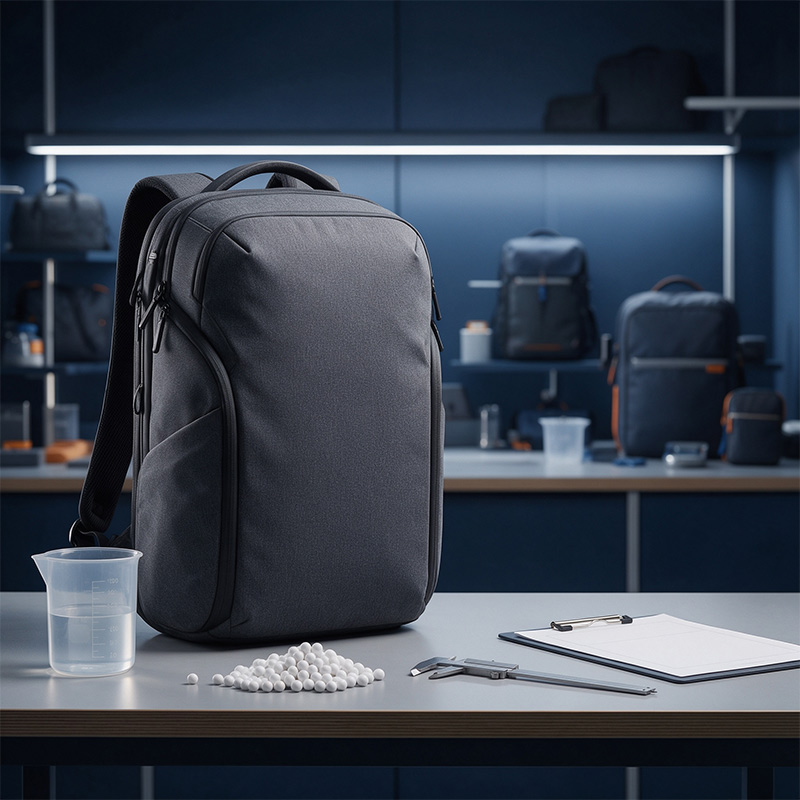
There are two widely used methods for measuring backpack capacity: geometric volume estimation and the ASTM F2153 fill test. During the design stage, the geometric formula (internal length × width × depth ÷ 1,000, multiplied by a pattern correction factor when necessary) can be used to estimate the maximum capacity. For sample approval and production capacity labeling, the unexpanded capacity measured using the ASTM F2153 fill test is generally used as the baseline. Geometric estimation is best suited to structured bags with regular shapes for preliminary space planning. Applying this method directly to sewn backpacks usually overestimates capacity. The fill test uses rigid plastic spheres with a diameter of 20 mm to fill all enclosed compartments; the spheres are then transferred to a calibrated measuring container to determine volume. The result can be used in purchase contracts, technical packs, inspection criteria, and product capacity labeling. For custom bag manufacturing, specifying the measurement method, included compartments, and tolerance alongside the capacity value helps align acceptance criteria between buyers and suppliers. Table of Contents Ⅰ. Why Backpacks with the Same Labeled Capacity Can Have Different Actual Volumes Ⅱ. Geometric Formula Estimation Ⅲ. ASTM F2153 Fill Test Ⅳ. Practical Recommendations for Backpack OEM Projects Ⅴ. Frequently Asked Questions (FAQ) Ⅵ. Conclusion Ⅰ. Why Backpacks with the Same Labeled Capacity Can Have Different Actual Volumes 1. Backpack Capacity Has No Globally Uniform Mandatory Labeling Standard Unlike shoe sizing or fabric weight, backpack capacity is not subject to a globally uniform mandatory labeling rule. Products labeled as 30 L may be measured using four common methods in the industry, producing different usable-volume results. Measurement method What is measured Typical result Notes Multiply external dimensions External length × width × height of the bag Likely to be overstated Counts fabric, foam, and back-panel structures as volume; unsuitable for labeled capacity. Main compartment only Largest enclosed main-compartment space Conservative Perceived usable space may exceed the labeled value, but the scope is limited and comparisons are less meaningful. Add all enclosed pockets Main compartment, zippered pockets, and covered enclosed pockets More comparable Closer to the logic of ASTM F2153; agree in advance whether open pockets are included. Promote expanded capacity Capacity with the roll-top or expansion zipper fully opened Represents maximum expanded state only Volume is lower in the normally closed state; some expanded bags may exceed airline carry-on limits. 2. Main Reasons for Differences in the Same Labeled Capacity For a daypack labeled 30 L, an external-dimension calculation includes space occupied by the back panel and shoulder-strap structure. Under the ASTM F2153 fill test, only enclosed compartments are counted; mesh water-bottle pockets and open front stash pockets are excluded. As a result, the unexpanded measured capacity may be only 24–25 L. Such differences are usually not manufacturing defects. They primarily result from different measurement methods and boundaries for what is included. 3. Capacity Must Be Matched to the Intended Use State Capacity can be reported as unexpanded capacity and expanded capacity. Unexpanded capacity refers to the bag in its normally closed, everyday-use configuration. Expanded capacity is the maximum volume available when a roll-top is fully opened or an expansion zipper is completely unzipped. A specification sheet that lists only one capacity value does not clearly identify the intended use state and makes inspection decisions more difficult. For roll-top bags and bags with expansion zippers, also verify the fully loaded external dimensions to determine whether the bag meets carry-on baggage size limits. Ⅱ. Geometric Formula Estimation 1. Basic Formula and Units A general geometric formula used in backpack OEM development is: Capacity (L) = Internal Length (cm) × Internal Width (cm) × Internal Depth (cm) ÷ 1,000 Example: With internal dimensions of 50 × 30 × 20 cm, the theoretical capacity is 50 × 30 × 20 ÷ 1,000 = 30 L. The formula uses centimeters and returns liters, based on 1 L = 1,000 cm³. For the North American market, capacity may also be listed in cubic inches; 1 L ≈ 61.024 cu in. 2. Appropriate Uses of the Geometric Formula • Reverse-engineering target dimensions during concept design: allocate internal usable dimensions based on the target capacity to support pattern and construction development. • Quickly estimating a capacity range during initial inquiries: when no physical sample is available, use external dimensions to make a preliminary assessment of the product category and support quotation and process evaluation. • Planning internal space before sampling: allocate space among the main compartment, laptop compartment, and front pockets, using the result as a theoretical upper-limit reference. 3. Why the Geometric Formula Can Be Inaccurate for Sewn Backpacks • The bag is not a perfect rectangular prism: daypacks that taper toward the top, roll-top bags, flap-top bags, and packs with curved suspension profiles have irregular shapes that cannot be accurately represented by a rectangular prism. • Fabric, foam, and suspension components reduce usable volume: laptop sleeves, back panels, and shoulder-strap anchor structures occupy space within the bag’s external profile. • Pocket-counting rules vary: external-dimension calculations may include side and front pockets, whereas standard fill testing counts enclosed compartments only and excludes open mesh pockets. • Seam allowances and lining thickness reduce usable space: sewing allowances, lining, and reinforcement materials reduce the effective internal volume. Conclusion: The geometric formula is a design-screening tool for estimating theoretical maximum volume; it should not be used directly as the labeled capacity of a sewn backpack. Results are more accurate for rectangular tote bags and simple travel duffels. For backpacks, technical outdoor packs, and styles with multiple complex compartments, capacity acceptance should be based on a fill test. 4. Early-Stage Estimation Before Sampling: Pattern Correction Factors During early development, before a physical sample is available, a pattern correction factor can help narrow the gap between theoretical and measured capacity. The adjusted formula is: Estimated capacity (L) ≈ [Internal length × internal width × internal depth (cm) ÷ 1,000] × K Select K according to the regularity of the bag’s shape. The ranges below are based on pattern databases and industry experience and are for design estimates only—not for official capacity labeling. The estimate must ultimately be calibrated against an ASTM fill test. Bag construction Reference correction factor Notes Boxy business backpack 0.80–0.85 Regular shape with high space efficiency. Standard daypack 0.75–0.80 Slightly contoured shape and space occupied by compartments. Outdoor hiking pack (internal aluminum-frame back panel) 0.70–0.75 Suspension system takes up more internal volume. Cylindrical duffel 0.72–0.78 Curved side walls reduce usable volume. Roll-top backpack 0.65–0.75 The rolled closure section is excluded from effective capacity. Tapered daypack, narrower at the top 0.70–0.78 The tapered cross-section makes the upper space less efficient. Example: A standard daypack with internal dimensions of 45 × 30 × 18 cm has a theoretical volume of 24.3 L. Using a correction factor of 0.78 gives an estimated capacity of approximately 19 L; subsequent fill testing will generally yield around 18–20 L. Important limitation: Correction factors are not universally transferable across factories or patterns. If the fabric weight or lining construction changes, re-test the bag and recalibrate K. In external technical communications, label this figure as a “design estimate,” not the contractual labeled capacity. Ⅲ. ASTM F2153 Fill Test 1. Standard Overview and Scope A commonly used industry standard for backpack capacity testing is ASTM F2153, “Standard Test Method for Measurement of Backpack Capacity.” It is a voluntary test method intended to establish consistent, comparable capacity-measurement rules among brands, factories, and inspection teams. Key principles: report both unexpanded and expanded capacity; count enclosed compartments only; exclude open mesh water-bottle pockets, open front stash pockets, and open compression pockets. The standard generally does not apply to small bags under 4 L. Crossbody mini bags, waist packs, and small organizers do not need to be labeled in liters; if a capacity value is provided, identify the alternative simplified test method used. 2. Standard Filling and Volume-Reading Procedure Step Procedure Control point 1. Prepare the test media Use uniform rigid plastic spheres with a diameter of 20 mm, commonly PP or PS. Foam beads and beans are for rough internal checks only; they compress or settle and have poor repeatability. Do not use them for official capacity labeling. 2. Fill all enclosed compartments Fill the main compartment and every zippered pocket. For roll-top bags, fill to the agreed number of rolls while ensuring normal closure. Close zippers after filling without pulling them taut. Do not omit any enclosed compartment. Exclude all open pockets. 3. Use a consistent settling procedure Gently shake the bag so the spheres settle naturally. A common procedure is three gentle shakes, approximately 10 seconds each. Do not deliberately press or compress the bag to inflate the reading. 4. Transfer the spheres to a calibrated measuring container Transfer all spheres into a graduated container calibrated by water-volume measurement. Gently agitate until the spheres settle, then record the volume. Large backpacks may be measured in multiple batches and the readings added together. Calibrate measuring equipment with water periodically and retain calibration records. 5. Repeat the test and average the results Conduct at least two independent tests. If the results differ by more than 1–2 L, filling or settling procedures may not have been consistent; repeat the test. Use the same spheres and measuring equipment for first-piece, in-line, and final inspections. 3. Limitations of the Standard and Its Relationship to Specification Sheets ASTM F2153 is voluntary and is not legally mandatory. Many retail product listings also omit the test method. The value of the test is that it allows the fill media, measuring equipment, included compartments, and tolerances to be defined in the specification sheet. If only a capacity number is listed without test details, results from different stages cannot be reliably compared. 4. When Full Laboratory Equipment Is Unavailable: Simplified Measurement Methods Not every inspection site has enough standard plastic spheres and calibrated measuring containers. A simplified method may be used during sampling, but the specification sheet must state that it differs from ASTM F2153. Scenario Simplified method Notes Compartments of 4 L or more Fill with 20 mm plastic spheres or uniform dry beans, then measure using a 1 L measuring cup and add the readings. Beans are for internal reference only; rigid plastic spheres are preferred for official capacity labeling. Compartments under 4 L Because small spheres stack with greater error, weigh the filling material first and convert to volume using a defined ratio if necessary. State in the documentation: “Not the ASTM F2153 standard procedure.” Curved or tapered bags Fill in vertical sections and add the readings from each section. A single rectangular-prism calculation will overestimate the capacity of tapered bags. Backpacks with multiple compartments Fill and measure each enclosed compartment separately, then total the results; list open pockets separately as excluded. Keep separate records to avoid confusion over what is included. Important: Capacity values obtained using different measurement methods should not be compared directly. Ⅳ. Practical Recommendations for Backpack OEM Projects 1. Recommended Capacity Fields for Specification Sheets To reduce the risk of a finished product’s capacity differing from expectations, include the following six items in the capacity section of the specification sheet: Field Recommended wording Purpose Measurement method “ASTM F2153 fill test using 20 mm PP spheres” / “Calculated from external dimensions; design reference only.” Identifies the method used to determine capacity. Unexpanded capacity Capacity in liters in the normally closed state. Matches typical use and product labeling. Expanded capacity Capacity in liters with the expansion zipper fully open or the roll-top fully unrolled. Distinguishes maximum expanded volume. Compartments included “Includes the main compartment and all zippered pockets; excludes mesh water-bottle pockets and open front stash pockets.” Removes ambiguity about which pockets count. Units List L and cu in together and specify the conversion. Supports reading preferences in different Western markets. Tolerance Agree on a tolerance by capacity range; use the same test method when judging compliance. Sets a reasonable acceptance range for inspection. 2. Example Wording for a Specification Sheet Capacity: 28 L unexpanded (approx. 1,709 cu in) / 34 L expanded (approx. 2,075 cu in), measured using the ASTM F2153 fill test with 20 mm PP plastic spheres. Includes the main compartment and all zippered pockets; excludes mesh water-bottle pockets and open front stash pockets. Tolerance: ±1.5 L. File the test record with the initial sample approval documents. 3. Suggested Tolerances and Contract Language Capacity range Suggested tolerance Application notes Under 20 L ±1 L Small bags are sensitive to compartment and opening design; test conditions must be controlled. 20–40 L ±1.5–2 L Common range for daypacks and commuter laptop backpacks. Over 40 L / large travel bags ±2–3 L Fill-test variation may be greater for large bags; additional repeats are recommended. Retail products with strict controls ±3%, or agree that “labeled capacity must not exceed measured unexpanded capacity.” Suitable for tightly controlled cross-border retail programs. Note: Tolerance criteria must correspond to the capacity test method. A tolerance established using external dimensions cannot be used to judge results from a fill test. 4. Common Capacity-Related Discrepancies in Custom Backpack Development Type of discrepancy Explanation Control measure Including open pockets in labeled capacity The counting method differs from ASTM and can produce inconsistent figures. Clearly list included and excluded pockets in the specification sheet. Advertising only expanded capacity Does not reflect volume in the product’s normally closed state. Provide both unexpanded and expanded capacity. Using external dimensions directly for sewn backpacks Foam, back panels, and lining take up space, so the calculated value is high. Use fill testing as the basis for labeled capacity; use external dimensions only as a supplementary reference. Using one capacity value for all sizes of a style Pattern and suspension structures change by size, affecting volume. Test each size independently. Testing only the first sample, with no production recheck Pattern adjustments, lining changes, and pocket revisions can change capacity. Test the approved reference sample and production trial units. Mixing metric and imperial units without labels Can lead to misinterpretation of readings. List both L and cu in in technical documents, with the primary unit suited to the target market. 5. Key Points When Comparing Multiple Samples Two products labeled with the same capacity may not perform equally in actual loading. Compare external dimensions, the main compartment’s internal usable dimensions, opening design, and photos of the bag when loaded. Even when both are labeled 30 L, a boxy pack and a tapered pack may accommodate different shapes of items. For travel backpacks and school backpacks, capacity is only one consideration. Flap-top designs are better suited to flat items, while top-loading roll-top bags offer good compression but can make items deep inside the bag harder to access. For a more complete assessment, include capacity, main-compartment internal dimensions, opening type, and fully loaded external dimensions in the specification sheet. 6. When to Conduct Capacity Tests Lock in the capacity baseline during initial sample approval. Once the first sample is complete, test capacity using the agreed method. After the parameters are approved, record them in the technical pack and purchasing documents before starting mass production. During inspection, use the same sphere specifications, measuring equipment, and settling procedure as for the approved sample, and assess the results against the agreed tolerance. 7. Capacity Records and Compliance Documentation Capacity testing is a technical specification activity and is separate from chemical testing of materials. Nevertheless, related records should be archived together for easy reference. If a product is labeled as using recycled fabric, the material claims should align with applicable GRS, GOTS, or OEKO-TEX documentation. Children’s backpacks sold in the United States must also meet applicable CPSIA requirements. A substantial discrepancy between labeled and measured capacity may create a risk of misleading advertising in the US and European markets. Store capacity test records and compliance certificates in the technical pack so they can be retrieved for customer factory audits and marketplace reviews. Ⅴ. Frequently Asked Questions (FAQ) Q1: Is backpack capacity accurately measured by multiplying length × width × height and dividing by 1,000? This formula estimates only the theoretical upper limit. It counts fabric, foam, and back-panel structures as volume and therefore generally overestimates usable space in sewn backpacks. The discrepancy is smaller for rectangular tote bags and simple travel duffels. For backpacks, outdoor packs, and styles with multiple compartments, capacity acceptance should be based on the ASTM F2153 fill test. A pattern correction factor can support early sampling estimates, but the result is for internal reference only and must not be used as the official labeled capacity. Q2: What is ASTM F2153? Are factories required to use it? ASTM F2153 is a voluntary test method for measuring backpack capacity; it is not legally mandatory. The core procedure is to fill all enclosed compartments with 20 mm rigid plastic spheres, transfer the spheres to a calibrated measuring container, and record both unexpanded and expanded capacity. Open water-bottle pockets and open stash pockets are excluded. The buyer and supplier should agree on whether to use the method in the technical documentation; once agreed, it becomes the basis for acceptance. Q3: Why does a factory label a backpack as 30 L when the fill-test result is only 25 L? This is usually due to differences in measurement methods—for example, using external dimensions or including open pockets in the calculation. A difference of around 20% between a daypack’s labeled capacity and its ASTM fill-test result is not unusual in the industry. Buyers and suppliers can establish a consistent basis for acceptance by agreeing in advance on the test method, pocket-inclusion rules, and tolerance range in the specification sheet. Q4: How should tolerances be set in a specification sheet, and which units should be used? For bags under 20 L, a tolerance of ±1 L is suggested; for 20–40 L, ±1.5–2 L; and for large bags over 40 L, ±2–3 L. For tightly controlled retail programs, the tolerance can be narrowed to ±3%, or the parties can agree that “the labeled capacity must not exceed the measured unexpanded capacity.” Use cubic inches (cu in) alongside liters for North America, while liters are generally preferred in Europe. Conversion: 1 L ≈ 61.024 cu in. Q5: How should capacity be tested for small bags under 4 L, waist packs, and organizers? ASTM F2153 generally does not apply to bags under 4 L. A simplified method can use a calibrated measuring cup, uniform dry beans, or a weight-to-volume conversion. The specification sheet must state that the method is “not the ASTM F2153 standard procedure.” Small spheres can stack inconsistently in small compartments, so external capacity claims for small bags should be made cautiously. Q6: Can rice or beans replace standard plastic spheres? They may be used for rough internal checks, but capacity figures used in contracts, specification sheets, or product labeling should not be based on rice or beans. Grains settle under pressure, and results vary between operators and batches, making repeatability poor. For formal testing, use 20 mm rigid PP/PS spheres and calibrated measuring equipment. Q7: For a roll-top backpack, how many rolls count as the unexpanded state under ASTM F2153? ASTM F2153 does not mandate a specific number of roll-top folds, which can lead to disagreement for this style. The buyer and supplier should agree in writing in the technical pack on the number of folds used for normal closure (commonly 2–3 rolls in the industry). Fill the bag to the agreed number of rolls and confirm that it closes normally without fabric tension; record this as the unexpanded capacity. The reading with the roll-top fully unrolled is the expanded capacity. Ⅵ. Conclusion From using geometric estimates to support early pattern planning, to determining labeled capacity through ASTM F2153 fill testing, and then specifying the test method, included compartments, and tolerances in clear technical terms, a verifiable capacity-assessment system is central to bag capacity management. Consistent criteria help project stakeholders avoid misunderstandings about specifications. As a professional bag manufacturer, we can support capacity-related technical requirements and help align project specifications with the agreed standards. Please contact us if you need assistance. Author
もっと見る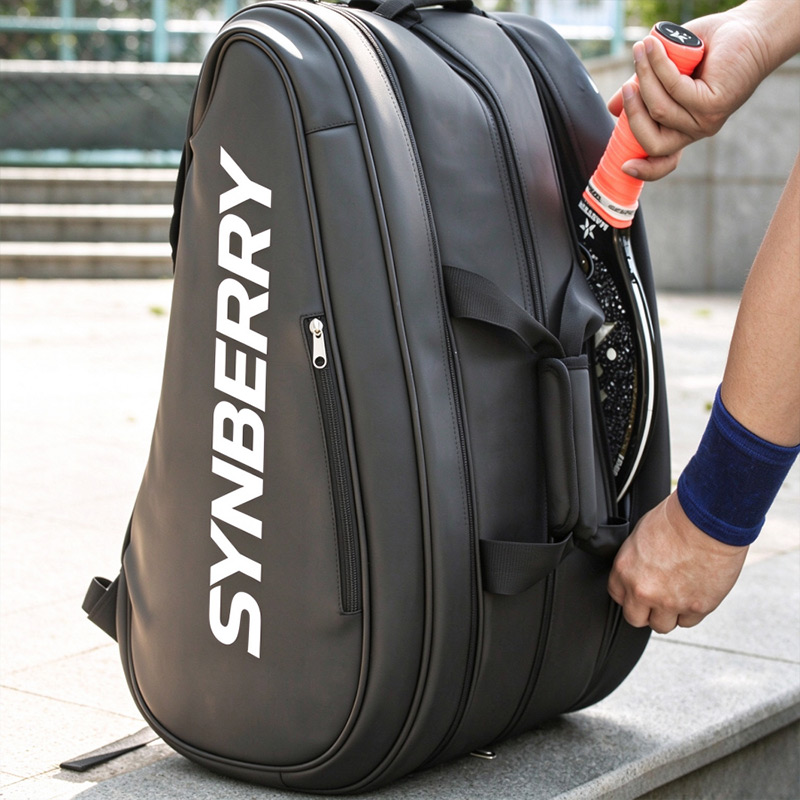
良質なピックルボールバッグは、科学的に設計された収納レイアウト、快適な持ち運びシステム、高品質な職人技、そして耐久性と耐水性に優れた素材という4つの基本基準を満たす必要があります。これら4つの要素すべてが揃って初めて、真に優れたピックルボールバッグと言えるのです。目次:科学実験室の設計快適な持ち運びシステム高品質な職人技耐久性があり、耐水性に優れた素材ブランド向けカスタマイズ推奨事項ピックルボールバッグのカスタマイズに関するよくある質問結論 1. 科学実験室の設計ピックルボールのパドルの表面は主にカーボンファイバーまたはグラスファイバーの複合材料でできており、圧力、傷、高温や直射日光への長時間の曝露に弱い。そのため、パドル専用の収納スペースは、優れたピックルボールバッグに欠かせない機能である。具体的には、優れたパドル収納部には以下の特徴が備わっているべきです。厚みのある断熱パドル収納部:専用のパドル収納部には、バッグを落としたり押しつぶしたりした際の衝撃を吸収する厚みのあるEVAまたはパールコットン製のクッション層が必要です。さらに、 アルミ箔断熱ライニング 屋外の高温に効果的に耐え、直射日光に長時間さらされることによるパドル面の変形を防ぐのに役立ちます。大容量のメインコンパートメント:メインコンパートメントは、衣類、タオル、水筒、その他のアイテムなど、日々のトレーニングや競技に必要なすべての必需品を収納できる十分なスペースを備えている必要があります。クイックアクセスボールポケット:メインコンパートメントの内側に、ピックルボール専用のメッシュまたは伸縮性のあるコンパートメントを追加します。独立したクイックアクセスボールポケットにより、ボールを衣類から物理的に分離できるため、ギアの清潔さと整理整頓を維持できます。また、ウォーミングアップ中や試合の合間に予備のボールを素早く取り出すことができ、メインコンパートメント全体を探し回る必要がないため、全体的な効率性と使いやすさが向上します。独立した通気性のあるシューズコンパートメント:メインコンパートメントとは隔離されているため、濡れたり汚れたりした靴がパドルや衣類を汚すのを防ぎ、不快な臭いを軽減します。これは、プロ仕様のピックルボールバッグと一般的なジムバッグを区別する重要な特徴です。複数の小型ポケット:携帯電話、鍵、オーバーグリップ、プロテクター、タオルなどの身の回り品やアクセサリーを収納できるように設計されています。隠し貴重品ポケット:柔らかいスエードの裏地付きで、傷つきやすい貴重品を安全に保管できます。 2. 快適な持ち運びシステムピックルボール用のバッグは、一般的にバックパック、ショルダーバッグ/クロスボディバッグ、手持ちとバックパックの両方で使えるコンバーチブルバッグの3つの持ち方があります。 バックパック:複数のパドルと装備一式を持ち運ぶのに理想的なバックパックで、その重要な特徴はショルダーストラップとバックパネルのデザインにあります。高品質のバックパックのショルダーストラップは、幅広で厚みがあり、高密度フォームが詰められ、通気性の良いメッシュ生地で覆われている必要があります。これにより、肩全体に圧力が分散され、空気の流れが促進され、長時間の着用でも過度の熱のこもりや圧迫痕を防ぎます。バックパネルには、EVAまたはPEパールコットンサポート層が組み込まれており、重い荷物による変形や潰れを防ぎます。また、背骨の自然な湾曲に沿うように設計され、安定した確実なサポートを提供します。ショルダーバッグまたはクロスボディバッグ:これらのバッグは軽量で持ち運びやすく、柔軟性を重視しているため、短時間のトレーニングや少量の荷物しか必要としない状況に最適です。ショルダーストラップは滑り落ちないよう十分な幅があり、ショルダーパッドには片方の肩にかかる負担を軽減するクッション層が組み込まれている必要があります。調節可能なショルダーストラップにより、身長の異なるユーザーでも快適なフィット感を得ることができます。コンバーチブルトート&バックパック:汎用性を重視するユーザーにとって、コンバーチブルトート&バックパックは優れた柔軟性を提供します。このタイプのバッグは通常、短距離の持ち運びや車への積み込みに便利な補強されたトップハンドルと、バッグを運ぶ際の手の負担を軽減し不快感を防ぐように設計されたパッド入りのサイドハンドルを備えています。バックパックモードに切り替えた際は、収納されているショルダーストラップを簡単に引き出してしっかりと固定できるため、どちらの形態でもスムーズな持ち運びが可能です。どのスタイルを選んだとしても、このキャリングシステムの究極の目標は、プレーヤーがコートへの行き帰りに快適で安心できる体験を提供することです。 3. 高品質な職人技職人技の細部へのこだわりが、ピックルボールバッグの耐用年数と全体的な外観、そして使い心地を直接左右する。縫製: 縫製は丈夫で耐久性があり、ステッチの間隔が均一で、縫い目がきれいで均一である必要があります。ショルダーストラップの取り付け部分、ハンドルの付け根、ファスナーの端など、主要なストレスポイントは、二重または三重のステッチで補強する必要があります。 バータック 引き裂き抵抗を向上させ、長時間の重荷重下で縫い目が裂けたり破損したりするのを防ぐための補強。金具:金具の選択は非常に重要です。ファスナーは滑らかで耐久性があり、一定レベルの防水性を備えている必要があり、YKKやSBSなどの信頼できるブランドのものが望ましいです。ファスナーの引き手は、スポーツグローブを着用していても簡単に握って操作できるようなデザインである必要があります。バックル:バックルは、繰り返し着脱してもひび割れや変形が生じないよう、疲労試験を実施する必要があります。また、生地の端は糸のほつれがなく、きれいに仕上げられている必要があります。さらに、バッグは中身が空の状態でも、形崩れせず、しっかりとした形状を保つ必要があります。こうした細部へのこだわりは、プロの品質と品質への配慮を反映しています。 4. 耐久性があり、耐水性に優れた素材ピックルボールは屋外でプレーされることが多く、バッグは突然の雨やコートの朝露にさらされる可能性があります。そのため、生地の防水性は、中の用具を保護するための第一の防御線となります。 4.1 主な生地:ナイロン対ポリエステル高品質のピックルボールバッグは、高密度ナイロン(600D以上など)またはポリエステル生地で作られているべきです。これらの素材は、優れた耐摩耗性と耐引裂性を持ち、撥水性にも優れています。ナイロン:この2つの一般的な素材を比較すると、ナイロンは強度対重量比が高く、耐摩耗性にも優れているため、高級ピックルボールバッグの素材として好まれています。表面は滑らかで手触りも柔らかいですが、価格は比較的高めです。ポリエステル:ポリエステルは紫外線耐性と色持ちに優れているため、直射日光に長時間さらされても色あせや劣化が起こりにくい。また、価格も手頃なので、コストパフォーマンスに優れた選択肢と言える。 4.2 防水コーティング高品質な生地素材だけでは、過酷な気象条件に耐えるには不十分です。バッグの撥水性を左右する重要な要素は、表面の防水加工です。 現在市販されているプロ仕様のピックルボールバッグのほとんどは、主に3つの加工方法のいずれかを採用しています。DWR(耐久性撥水)コーティング、PUコーティング、またはTPUコーティングです。DWR撥水加工:DWRコーティングにより、バッグの表面に蓮の葉のような効果が生じ、水滴が生地に浸透することなく、玉状になって素早く転がり落ちます。これにより、雨水がバッグ内部のギアに染み込むのを効果的に防ぎます。PU防水コーティング:PUコーティングは通常、生地の内側に施され、緻密な防水膜を形成します。これにより、外部からの湿気の浸透を防ぐだけでなく、生地全体の構造と耐引裂性も向上します。TPU防水コーティング:熱可塑性ポリウレタンエラストマーであるTPUコーティングは、通常、生地の内側に薄膜としてラミネート加工されるか、別層として組み込まれます。PUコーティングと比較して、TPUは優れた耐加水分解性と低温での柔軟性を備えています。低温多湿環境下でも劣化、硬化、ひび割れが起こりにくく、長期使用においてもバッグの防水性能を維持するのに役立ちます。 5. ブランド向けカスタマイズ推奨事項自社ブランドでピックルボールバッグを開発する予定がある場合、以下の3つの主要分野に関する推奨事項は、製品性能、コスト、ターゲット層の間で適切なバランスを取るのに役立ちます。 5.1 主な生地選びに関する推奨事項生地は、ピックルボールバッグの外観、手触り、耐久性、そして価格設定の可能性を左右します。以下の表は、製品のポジショニングに基づいた生地選びの推奨事項を示しています。生地の選択肢共通仕様強度/耐摩耗性紫外線耐性料金推奨配置ポリエステル600D / 900D★★★☆★★★★☆(色褪せしにくい)適度コストパフォーマンス重視のモデル、エントリーレベルのモデル、そして長時間の屋外日光曝露に適した製品ナイロン600D / 1680D バリスティックナイロン★★★★★(丈夫で軽量)★★★(紫外線処理推奨)中~高プロ選手向けの中級~高級モデルとバッグナイロン+リップストップ/ジャカードチェック柄ナイロン、ハニカム模様★★★★★★★★高い高級モデルとデザイナーブランド複合メッシュ生地(PVC/EVA)500D~1000D★★★★☆★★★☆適度ビーチや多目的に使える、防水性能を強化したモデルとバッグ。主な選定基準:大量販売モデルの場合は、600Dポリエステルを優先的に使用してください。コスト管理が容易で色落ちしにくいため、主流のエントリーレベル製品で人気の素材です。中級~高級モデルには、1000Dまたは1680Dのバリスティックナイロンを検討してみてください。その高い強度と優れた耐水性は、中級~高級市場に適しています。環境に優しい選択肢:ECONYL®などの再生ナイロンや再生ポリエステル(RPET)を検討し、GRSなどの国際的に認められた認証を支持することで、欧州および北米市場における持続可能な製品への高まる需要に対応しましょう。 5.2 容量選定に関する推奨事項容量に関しては、大きい方が必ずしも良いとは限りません。理想的なサイズは、対象ユーザーのプレーシーンや持ち運び習慣に合致している必要があります。以下の表は、OEM向けピックルボールバッグ開発における容量設計の推奨事項を示しています。容量区分パドル容量標準構成対象読者参考寸法(長さ×幅×高さ)軽量モデルパドル1~2本メインコンパートメント+ボールポケット+ウォーターボトルホルダー。通常は靴収納部なし。カジュアルにプレイする人や、ウォーキングとピックルボールを組み合わせる人約45×20×25cm標準モデル(推奨)パドル2~4本パッド入りパドル収納部+メイン収納部+独立したシューズ収納部+ボールポケット+小物収納部クラブの中核メンバーと定期的にダブルスをプレーするプレイヤー約50×25×32cm業務用大容量モデルパドル4~6本パッド入りパドル収納部 + 大きなメイン収納部 + 独立したシューズ収納部 + ボールポケット + 防水ポーチプロの選手とコーチ約55×30×38cm旅行/チームモデルパドルが6本以上キャスター付きスーツケース型バッグ、または外部取り付けシステムを備えた特大バックパックチームでの大量購入や頻繁に遠征する選手約60×35×45cm主な選定基準:標準モデルが最適だ。パドル2~4本収納できるバッグは、幅広いプレーヤーのニーズを満たすことができる。新しいピックルボールバッグ製品ラインを開発するブランドは、この容量を主力製品として検討すべきだろう。軽量モデルは、顧客獲得や販促用景品に最適です。シンプルな構造と低価格のため、エントリーレベルのセットの付属品として、あるいはクラブイベントの記念品として適しており、新規プレイヤーの参入障壁を下げます。プロ仕様の大容量モデルは、単に収納スペースを増やすよりも、収納効率を優先すべきです。コーチやプロ選手が持ち運ぶ膨大な用具を整理するという課題に対処するには、取り外し可能な仕切りやモジュール式の内部コンパートメントを検討しましょう。これらの機能により、パドルや衣類を様々な組み合わせで収納でき、内部を整理整頓された状態に保つことができます。旅行用/チーム用モデルは、旅行に便利な機能を優先すべきです。特大容量に加え、標準的な荷物固定ストラップと耐摩耗性の保護脚を備えている必要があります。これらの機能は、空港での乗り継ぎや長距離移動中にピクルボールバッグをスーツケースにしっかりと固定し、バッグの底面の摩耗を軽減するのに役立ちます。 6. FAQ:ピックルボールバッグのカスタマイズに関するよくある質問 Q1:ピックルボールバッグとテニスバッグの違いは何ですか?互換性はありますか?一時的には互換性がある場合もありますが、推奨はしません。ピックルボールのパドル(長さ約40cm)はテニスラケットよりも短いため、テニスラケット用の収納スペースでは空きスペースが大きくなりすぎて、パドルが動いて他のアイテムとぶつかる可能性があります。また、ピックルボールバッグには、硬質プラスチック製のピックルボールは過度の圧力で破損する可能性があるため、専用のボールポケット、シューズ収納スペース、その他の小物収納スペースが備わっているのが一般的です。ピックルボールしかプレイしない場合は、専用のピックルボールバッグの方がはるかに快適に使用できます。 Q2:バッグの防水性能はどのように確認できますか?撥水性があるということは、防水性があるということですか?いいえ。DWRコーティングによる撥水性は、小雨や水しぶき程度であれば一般的に十分ですが、ファスナー部分からは水が浸入する可能性があります。より完全な防水性を求めるなら、PU/TPUコーティング生地またはラミネート加工された防水生地と、YKKの防水ファスナーシリーズのような防水ファスナーの組み合わせが必要です。購入の際は、製品仕様に生地コーティングと防水ファスナーの両方が記載されているか確認してください。 Q3:ピックルボールのパドル収納部に断熱材が必要なのはなぜですか?夏の暑さでパドルが損傷することはありますか?はい。カーボンファイバーまたはグラスファイバーの表面とポリプロピレンハニカムコアで作られたピックルボールパドルは、高温や直射日光に長時間さらされると、表面が柔らかくなったり、層間剥離を起こしたり、打球感が変わったりすることがあります。アルミホイルの断熱ライニングはバッグ内部の温度を大幅に下げることができ、プロ仕様のピックルボールバッグと安価なモデルを区別する重要な特徴の1つとなっています。 Q4:カスタムピックルボールバッグの一般的な最小注文数量(MOQ)と納期はどれくらいですか?SYNBERRYの標準最小注文数量(MOQ)は約500個です。サンプル作成のリードタイムはデザインの複雑さによって異なりますが、通常2~3週間です。量産リードタイムは注文数量と製造の複雑さによって変動します。全面印刷、反射ストリップ、カスタム成形バックルなどの特殊加工には、さらに時間がかかる場合があります。 Q5:ピックルボールバッグにはナイロンとポリエステルのどちらを選ぶべきでしょうか?どちらの方が耐久性がありますか?どちらの素材も耐久性に優れていますが、それぞれ異なる利点があります。ナイロンは強度が高く、手触りも優れているため、中級から高級製品に適しています。一方、ポリエステルは耐紫外線性、色持ちの良さ、そして価格の安さが優れているため、長時間の屋外日光にさらされるコストパフォーマンスの高いモデルに最適です。予算に余裕があればナイロンを、コストパフォーマンスを重視するならポリエステルを選びましょう。 7.結論ピックルボールは世界的に参加者数が爆発的に増加しており、ピックルボールバッグは単なる補助器具から専門的な製品カテゴリーへと進化を遂げています。スポーツバッグブランドにとって、これは新興市場への参入機会であるだけでなく、より洗練された製品開発を通じてプロフェッショナルなブランド認知度を確立するための重要なチャンスでもあります。優れたピックルボールバッグは、単なる収納スペースの集合体であってはなりません。エンドユーザーのニーズを深く理解し、彼らの期待に応える思慮深い製品であるべきです。高価なラケットを保護する断熱技術から、アクセス効率を高める収納レイアウト、屋外環境向けに設計された耐候性素材まで、あらゆる細部に至るまで、プレーヤーのスポーツ体験への敬意が感じられます。この記事は、ピックルボールバッグメーカーの視点から書かれており、ピックルボールバッグ製品ラインを開発するブランドに対し、顧客ニーズの理解から製品の生産開始までを網羅した包括的な参考ガイドを提供することを目的としています。 著者
もっと見る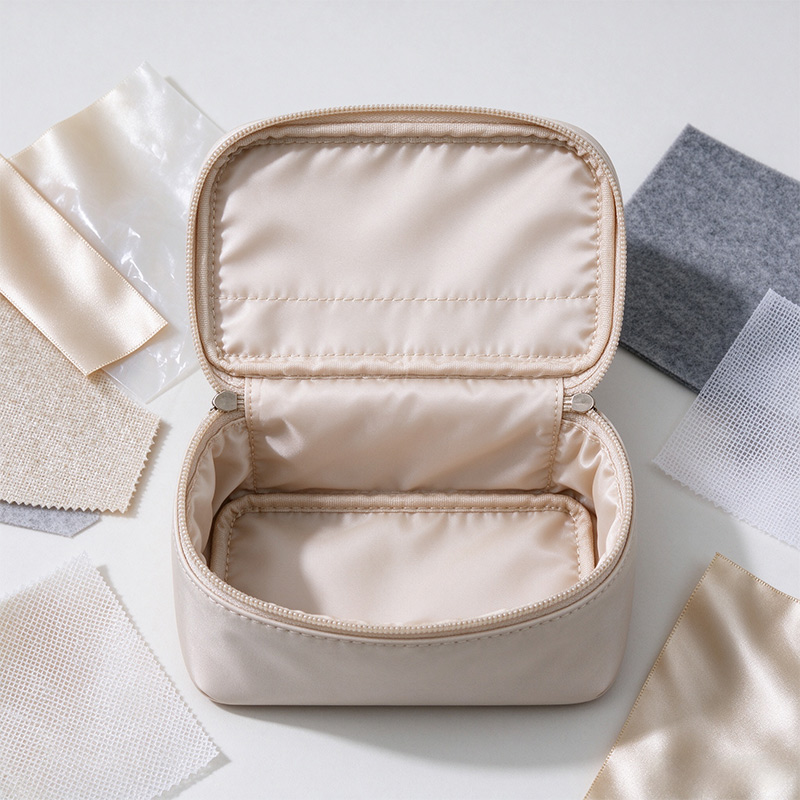
化粧ポーチの裏地として最も一般的に使用されている素材は、ポリエステル系の生地、特にポリエステル平織り、ポリエステルタフタ、ポンジー、コーティングポリエステルです。また、防水性や漏れ防止性が求められる製品には、ナイロン、TPU、PEVA、PVC、EVAがよく使用されます。サステナブルなブランドラインには、RPETリサイクルポリエステルとリサイクルナイロンが適しています。高級感のある手触りやギフトとしての位置づけには、マイクロファイバー、フェイクスエード、ベルベット、サテンが適しています。 綿、キャンバス、綿ポリエステル混紡、綿麻混紡も化粧ポーチの裏地として使用できます。特にキャンバス地の化粧ポーチ、ナチュラルスタイル、環境に配慮した製品、刺繍の質感が必要な製品に適しています。ただし、これらの素材は防水性、防汚性、お手入れのしやすさといった点で、コーティングされた合成繊維とは異なる場合が多く、具体的な使用状況に基づいて評価する必要があります。 目次:・機能要件による選定・ライニング選定のための主要技術パラメータ・裏地のカスタマイズプロセスとロゴの表示方法• ブランド向けに、全工程における材料品質管理をどのように確保するのか?よくある質問• 結論 Ⅰ.機能要件に基づく選定と一般的な生地の分析化粧ポーチの裏地を選ぶ際の基準は、一般的に、汚れにくさ、防水性、化粧品の保護、お手入れのしやすさ、形状保持性、そしてサポート力です。以下のセクションでは、機能的な要件別に、よく使われる生地の特性、適用シーン、および注意事項について説明します。 1. 防水性と清掃のしやすさのカテゴリー・PVC/TPUフィルム:機能性化粧品バッグやウェット/ドライ分離コンパートメントによく使用され、優れた防水性と漏れ防止性能を備えています。液体が飛び散った後も簡単に拭き取ることができます。PVCは優れた防水性能と透明性を提供しますが、欧米市場においてはREACH規則およびカリフォルニア州プロポジション65への適合リスクを慎重に評価する必要があります。TPUは環境への優しさ、耐紫外線性、柔軟性において全体的に優れているため、高級防水スタイルには好ましい素材となっています。・PEVA:塩素を含まない、PVCに代わる環境に優しい素材で、優れた防水性と拭き取りやすさを備えており、サステナビリティを重視するブランドに適しています。長期間の紫外線照射により若干の黄変が生じる可能性があるため、サンプリング段階で評価する必要があります。・EVA:一般的に硬質のインナートレイや成形ライニングに使用され、優れた防水性能と構造的サポートを備えており、形状保持が求められる化粧ポーチのインナーコアに適しています。・コーティングポリエステルおよびコーティングオックスフォード布(例:PUコーティング、TPUコーティング):ポリエステルまたはオックスフォード布にコーティングを施すことで、裏地表面に連続した膜が形成され、リキッドファンデーションやスキンケアウォーターなどの液体が染み込むのを効果的に防ぎます。耐摩耗性、耐引裂性に優れ、コストパフォーマンスも良好で、手頃な価格の大容量化粧ポーチや日常使いの機能的なスタイルに適しています。ただし、コーティングや縫製は完全な防水性を保証するものではありませんのでご注意ください。・ポリエステル平織り、ポンジー、ポリエステルタフタ:安定した供給、高い裁断・縫製効率、そして安定した染色堅牢度により、大量注文における異なるロット間での裏地色の一貫性を確保します。中でも、ポリエステルタフタは軽量かつ高密度で、滑らかで引っかかりにくく、軽量です。ポンジーと平織りは、マスマーケット向けのスタイルに適しています。基本的な防水性を求める場合は、ライトコーティングバージョンを選択できます。・ナイロンタフタ:滑らかな手触りで、同仕様のポリエステルよりも優れた引裂強度を持ち、中級~高級化粧ポーチ製品に適しています。ナイロン自体にも一定の防水性があり、防水性と洗浄の容易さを兼ね備えた裏地としてよく使用されます。軽量性、耐久性、旅行での使用を重視する製品であれば、ナイロンは検討に値する選択肢です。【補足】コーティングされた生地は、飛沫を防ぐ効果しかありません。通常の縫製では針穴ができ、縫い目から液体が染み込む可能性があります。完全な防水性が必要な場合は、追加のシームシーリング(熱溶着)処理が必要です。 2. 形状保持性とクッション性カテゴリー・フェルト:高い剛性と優れたサポート力で、化粧ポーチの立体的な形状を維持し、適度なクッション性と衝撃吸収効果を発揮します。パウダーコンパクトやアイシャドウパレットなどの保護が必要なカスタムインナーポーチや製品に適しています。重量、洗浄方法、厚みには注意が必要です。・フリース素材(例:マイクロファイバーフリース、フェイクスエード、ベルベット):繊細な手触りで、適度な弾力性があり、化粧品ボトルの滑りや傷を軽減します。中級~高級化粧品バッグに適しています。マイクロファイバー、フェイクスエード、ベルベットは、上質な触感と滑り止め効果があり、主に高級ブランド製品に使用されています。3. 高級テクスチャカテゴリー・アセテートサテン:滑らかで柔らかな手触り、温かみのある光沢、優れたドレープ性としわになりにくさ、化粧品の出し入れがスムーズで、メイクブラシの毛が引っかかることがなく、軽やかな高級感のあるポジショニングに適しています。・普通サテン/サテン生地:表面が滑らかで肌に優しく、柔らかな光沢があり、洗練された印象を与えます。ギフトやデザイン性を重視する製品に適しています。引っ掛かりやすさ、耐摩耗性、色落ちの堅牢度を評価する必要があります。ポリエステルサテンとナイロンサテンは印刷効果が優れており、高級裏地に適しています。4. 環境に優しいリサイクルおよび持続可能なカテゴリー・RPET:リサイクルPETボトルを粉砕、洗浄、紡績して作られた糸です。手触り、色落ちのしにくさ、耐摩耗性はバージンポリエステルとほとんど変わらず、従来のポリエステル平織りやタフタの代替として、ほとんどの一般的な化粧ポーチの裏地に適しています。ESGコンセプトを実践するブランドでよく使用される素材です。・再生ナイロン:主に廃棄された漁網、カーペット繊維、その他の産業廃棄物から作られ、解重合と重合によって再生されます。再生PETと比較すると、再生ナイロンは強度、弾性、耐薬品性に優れ、より繊細で滑らかな手触りですが、市場供給は再生PETよりも不安定で、価格も通常再生PETよりも高くなります。5. ナチュラルスタイルとブレンドカテゴリー・コットン:自然な手触り、肌に優しく、吸湿性があり、ナチュラルスタイルに適しており、環境に配慮した素材で、キャンバス地の化粧ポーチの裏地としても使用できます。・キャンバス:グラム数が高く、構造的なサポート力に優れ、耐摩耗性があり、化粧ポーチ、トイレタリーバッグ、旅行用収納バッグの裏地や外ポケットに適しています。裏地として使用する場合は、重量、厚み、縫製工程を総合的に考慮する必要があります。綿100%のキャンバスは通気性が良く軽量で、パウダー製品やメイクブラシなど、通気性が必要なアイテムに適しています。一般的な綿やキャンバス地は防水性がなく、色や汚れを吸収しやすい。液体化粧品が直接付着すると、洗浄が困難になる。そのため、取り外し可能な洗濯可能な内袋、コーティング加工、独立した防水袋、または内部仕切り構造などを組み合わせるのが一般的な対策である。 ・綿・ポリエステル混紡:綿の自然な風合いとポリエステルの耐久性および寸法安定性をバランスよく兼ね備えており、質感と大量生産の一貫性を両立させる必要があるプロジェクトに適しています。・綿麻混紡:自然な風合いが際立ち、特定のスタイルブランドに適していますが、サンプル段階で防汚性と色落ちの堅牢性を確認する必要があります。6. その他の実務的なカテゴリー・PUライニング:表面は凹凸があり、拭き取りやすく、日常の通勤や中級品に適しています。表面は緻密で、リキッドファンデーションや口紅などの油性汚れの浸透を効果的に防ぎます。湿らせた布で簡単に拭き取ることができ、メンテナンスコストも低く抑えられます。特に高温多湿環境では、長期使用後のコーティングの剥がれやべたつきを防ぐため、耐加水分解性に優れたPU素材を選ぶようにしてください。・メッシュ/三層メッシュ:通気性に優れ、軽量で、化粧ポーチの内側仕切り袋やブラシ収納層によく使用され、アイテムの素早い識別と内部の湿気の放出を促進し、カビの発生リスクを低減します。ただし、表面が不均一で孔が大きいため、汚れが溜まりやすく、完全に洗浄するのが困難です。液体化粧品に直接触れるメインの裏地としては推奨されず、通常は防水インナーバッグと併用する必要があります。Ⅱ.ライニング選定のための主要技術パラメータ化粧ポーチの裏地生地を選ぶ際には、以下の要素が最終製品の品質とユーザーエクスペリエンスに直接影響します。サンプル段階で各項目を確認することをお勧めします。 1. グラム重量と厚さ・低グラム重量(例:30~50gsmのポリエステルタフタまたはポンジー):軽量で柔らかく、内部スペースを最大限に活用し、全体の重量を軽減します。究極の携帯性と軽量性を追求する旅行用化粧ポーチに適しています。・中程度のグラム重量(例:60~100gsmの平織りポリエステル、ナイロン、または綿):手触りと耐久性のバランスが良く、一般的な化粧ポーチの主流素材です。この範囲の生地は適度な硬さがあり、バッグの基本的なシルエットを維持しつつ、縫製の安定性と耐摩耗性に優れているため、毎日の通勤や多機能な収納シーンに適しています。• 高グラム重量(例:120gsm以上の厚手のキャンバス、厚手のコーティング生地、または複合フェルト):優れた剛性と構造的サポートにより、化粧ポーチの立体形状を効果的に維持し、内部アイテムの圧縮による変形を防ぎます。ハードケースの化粧ポーチや、自立する必要のある内部デザインによく使用されます。 2. コーティングの種類と防水性能コーティングの種類防水性能耐摩耗性環境への配慮代表的な用途PUコーティング良い良い中くらいデイリーコスメポーチTPU複合材素晴らしい素晴らしい素晴らしい高級防水スタイルPEVA良い中くらい良い環境に配慮したポジショニングスタイルPVC素晴らしい良いコンプライアンスには慎重な評価が必要です透明なスタイルエヴァ良い良い 中くらい成形されたインナートレイ、硬質ライニング 3.染色堅牢度、耐摩擦性、および色の選択・裏地は、注文対象市場およびブランドの要件を満たすため、乾摩擦および湿摩擦による染色堅牢度試験に合格する必要があります(ASTM/ISO業界試験規格を参照)。・色の選択は、ブランドビジョン、ターゲット市場の使用習慣、清掃・メンテナンスに関する期待、そして全体的なデザインを総合的に考慮する必要があります。・濃い色や中間色のシステムは、日常使用において汚れが目立ちにくい傾向があります。明るい色のシステムは清潔感があり、一部のブランドイメージには適していますが、化粧品の残留物が目立ちやすいため、コーティング、イージークリーニング仕上げ、または取り外し可能な洗濯可能な内袋を組み合わせることができます。 4. 破断強度と引裂強度・裏地生地の破断強度と引裂強度は、ASTM D5034などの業界一般試験規格に準拠する必要があります。・具体的な指標は、製品のポジショニング、使用シナリオ、およびブランド品質の要件に合致している必要があります。 5. 手触り、音、折り畳み時の弾力性、縫製との相性・ナイロンやコーティングされた布地は摩擦音を発する可能性があり、サンプリング段階で評価する必要がある。・マイクロファイバー、フェイクスエード、キャンバスなどの素材は、厚みが縫製効率や完成品の重量に与える影響に注意が必要です。・コーティング材やフィルム材については、折り畳んだ後に白化しないか、弾力性が安定しているか、縫い目から漏れがないかなどに注意を払う必要がある。 6.洗浄方法と消費者の使用シナリオ・製品が日常のオフィス、旅行、フィットネス、その他のシナリオを想定している場合、裏地は拭き取りやすさと漏れ防止性能を優先すべきです。・製品が自然なスタイルや取り外し・洗濯可能なデザインを重視している場合は、綿、キャンバス、綿ポリエステル混紡素材を検討し、取り外し可能な内袋や防水収納袋と組み合わせることができます。・商品がギフト用または高級ブランドとして位置づけられている場合は、サテン、マイクロファイバー、フェイクスエードなどを検討することができ、お手入れ方法は説明書に明確に記載する必要があります。 Ⅲ.裏地カスタマイズ工程とロゴ表示方法1. 裏地のカスタマイズ寸法・色のカスタマイズ:パントンカラー番号に基づいた染色。初回のご注文には、色確認のための予約期間が必要です。・質感のカスタマイズ:平織り、綾織り、ジャカード織り、サテン、パール調、その他表面効果。• 印刷のカスタマイズ:全面印刷のブランドパターン、ロゴの繰り返し印刷、季節ごとのグラフィックなど。・構造のカスタマイズ:ブラシポケット、透明な内袋、ファスナー付き隠しポケット、ゴムバンド固定位置など。・複合材料:防水性や手触りの要件に応じて、コーティング、ラミネート加工、接着、エンボス加工などの工程を組み合わせることができます。 2. ロゴプロセスの選択プロセス適用可能な裏地タイプ耐久性プロセス特性シルクスクリーン印刷ポリエステル、ナイロン、キャンバス、その他の生地中くらい直接的な色彩表現熱転写印刷ポリエステル、ナイロン、キャンバス、その他の生地良い優れたパターンディテール表現刺繍ポリエステル、ナイロン、キャンバス、その他の生地素晴らしい強い立体感織りラベル全種類素晴らしい低コストメタルラベル全種類素晴らしい高級感のある雰囲気ホットスタンピング/箔押しサテン、フェイクスエード、PUレザー中くらい高級感のある雰囲気 3.ブランド裏地の付加価値・カスタムプリントの裏地やブランドロゴ入りの織りラベルは、製品の開封体験とブランド認知度を高めることができます。・DTCブランドやギフトチャネルにおいては、ブランドロゴ入りの裏地は、知覚価値を高めるための重要な手段となる。・裏地のカスタマイズは外袋のデザインの柔軟性に影響を与えず、外袋の生地、ファスナー、パッケージと合わせて総合的なブランドソリューションを形成できます。 Ⅳ. ブランド向けに、全工程における材料品質管理をどのように確保するのか?1. 化粧ポーチOEM前のコミュニケーション:・要件確認:顧客の製品ポジショニングとターゲット市場を理解する。・生地の選択:裏地の素材、グラム重量、コーティング、色を確認してください。 2. サンプリング段階・サンプリング:サンプルを作成し、手触り、色、構造を確認します。(正式な注文を行う前に、少なくとも1回の実物サンプル確認を行うことをお勧めします。)・サンプル確認:サンプリング段階で、裏地の色、手触り、厚み、コーティング、ロゴ加工、縫製効果、クリーニング性能を同時に確認します。・コンプライアンス要件:製品が欧州および米国市場向けである場合、サンプリング段階で対象市場のコンプライアンス文書および試験体制を同時に確認することができます。 3.主要な品質管理チェックポイント・入荷資材検査:生地の色差、グラム重量、幅を確認します。・裁断工程:生地表面の欠陥とコーティングの均一性を確認します。・縫製段階:裏地とファスナーの接合部が平らになっているか、縫い目が飛んでいないかを確認します。・完成品段階:裏地の洗浄テストとファスナーの滑らかさテストを実施する。・出荷検査:SYNBERRY AQL 1.5/4.0のサンプリング基準に従って、外観および機能検査を実施します。 4. 裏地洗浄試験方法の参考・実際の製品開発においては、水のみを用いた試験ではなく、実際の化粧品を用いて裏地洗浄効果の比較試験を行うことができる。・候補となる裏地サンプルをそれぞれリキッドファンデーション、口紅、日焼け止め、その他の化粧品にさらした後、同じ洗浄方法と拭き取り頻度で処理し、残留物の状態を比較する。・この方法は、サンプリング段階でライニングソリューションの実用性能を効果的にスクリーニングできる。 Ⅴ.よくある質問(FAQ)Q1:化粧ポーチの裏地として最も一般的な素材は何ですか?綿やキャンバス地は使用できますか?A:ポリエステル平織り、ポリエステルタフタ、ポンジー、コーティングポリエステルは、化粧品バッグの裏地として広く使用されており、特に大衆向けや従来型の機能性を重視したスタイルに適しています。化粧ポーチの裏地には、綿、キャンバス、綿ポリエステル混紡、綿麻混紡なども使用できます。特にキャンバス地の化粧ポーチ、ナチュラルスタイル、環境に配慮した製品、刺繍の質感が必要な製品に適しています。ただし、綿やキャンバスは通常防水性がなく、汚れや色移りしやすいという欠点があります。取り外し可能な洗濯可能な内袋、コーティング仕上げ、または独立した防水ポーチとの組み合わせをお勧めします。防水性と漏れ防止性を重視する場合は、TPU、PEVA、PVC、EVAがより一般的です。持続可能性を重視する場合は、RPETリサイクルポリエステルやリサイクルナイロンが選択肢として増えています。 Q2:裏地生地のサンプル作成にはどれくらい時間がかかりますか?A:一般的なポリエステルまたはナイロンの裏地サンプルは比較的早く、通常15~20日程度です。コーティング生地やカスタムプリントの裏地は、より時間がかかります。カスタム染色やパントンカラーマッチングが必要な場合は、追加の色確認期間が必要になります。正式な注文を行う前に、少なくとも1回の現物サンプル確認を完了することをお勧めします。具体的なサンプルスケジュールは、工場にご確認ください。 Q3:欧米市場では、PVCライニングとPEVAライニングのどちらを選ぶべきでしょうか?A:PVCライニングは最高の防水性能と高い透明度を誇りますが、塩素やフタル酸エステルの問題から、EU REACH規則やカリフォルニア州プロポジション65への準拠リスクが高いという課題があります。PEVAは塩素を含まず、より環境に優しい代替品であり、サステナビリティを重視するブランドに適しています。 Q4:カスタムプリント裏地の最小注文数量(MOQ)と納期はどのように決定されますか?A:カスタムプリント裏地の最小注文数量(MOQ)は、通常、柄の複雑さ、印刷方法、生地のカスタマイズ度合いに基づいて交渉されます。シルクスクリーン印刷は大量生産に適していますが、デジタル印刷は少量生産にも対応できますが、単価が高くなります。納期に関しては、プリント裏地の生産サイクルは通常、無地の裏地よりも長くなります。従来の印刷のMOQは500枚からとなります。具体的なMOQと納期は、工場による評価に基づきます。 Q5:裏地生地の品質をどのように判断すればよいですか?A:工場では通常、グラム重量が仕様要件を満たしているか、コーティングが均一で剥がれがないか、染色堅牢度が業界標準の試験に合格しているか、破断強度が基準を満たしているか、縫製後にしわや糸切れが発生していないか、といった点から評価を行います。サンプリング段階では、目視検査だけでなく、実際の化粧品を用いて洗浄比較試験を行うことができます。量産段階では、原材料の受入検査、裁断検査、縫製検査、出荷サンプリング検査などを通じて、体系的な管理を行うことができます。 Q6:化粧ポーチの裏地は、防水性とカスタムロゴの両方を実現できますか?A:はい。一般的な解決策としては、コーティングされたポリエステル裏地に熱転写印刷でロゴを入れる方法、TPU生地にシルクスクリーン印刷でブランドロゴを入れる方法、裏地に織りラベルや印刷ラベルを付ける方法などがあります。ただし、コーティング面によってはインクの密着性に影響が出る場合がありますのでご注意ください。サンプル作成段階でロゴの密着性をテストすることをお勧めします。 Q7:裏地は色褪せたり、化粧品を汚染したりしますか?A:このようなリスクが存在するため、裏地生地は乾摩擦堅牢度試験と湿摩擦堅牢度試験の両方を実施し、対象市場の基準を満たす必要があります。特に濃色生地は、湿摩擦指標の重要な検証が必要です。サンプリング時に色褪せ試験を同時に実施することで、裏地の染色が完成品の化粧品を汚染するといったアフターサービス上の問題を回避できます。 Ⅵ.結論プロのバッグOEM/ODM製造工場として、当社はブランドやバイヤーの皆様に、裏地生地の選定、サンプル確認、ロゴ加工のカスタマイズから量産、出荷品質管理まで、ワンストップサービスを提供しています。マスマーケット向けのベーシックなスタイル、防水・防漏機能を備えた機能的なスタイル、触感を重視したハイエンドなスタイル、あるいはサステナブルなブランドラインなど、お客様のターゲット市場や製品ポジショニングに合わせて、最適な裏地ソリューションとサプライチェーンリソースをご提案いたします。裏地生地のサンプルをご希望の場合、または具体的なプロジェクト要件についてご相談されたい場合は、お気軽に当社営業チームまでお問い合わせください。 著者
もっと見るぜひ読んで、投稿を続け、購読してください。ご意見をお聞かせください。




著作権
@2024 Synberry Bag & Package Products Co.,Ltd 無断転載を禁じます
.
 サポートされているネットワーク
サイトマップ / ブログ / Xml / プライバシーポリシー